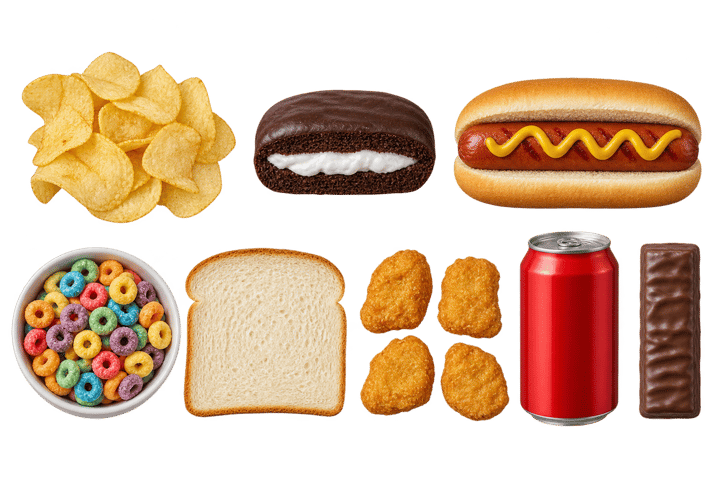
Ultra-processed food is faster than full
On this page
Ultra-processed food goes down faster than your fullness can keep up. On a US government research ward, people ate it 17 calories a minute faster and ate 508 more calories a day, on menus matched for sugar, fat, fiber and salt. Call it faster than full. Make most of what you eat food a kitchen could make, swap the packaged staples you buy every week first, and judge every food by what’s in it too, since the group says how a food was made and nothing about its protein or fiber.
Extra calories eaten a day on the ultra-processed menu
Weight lost in 8 weeks, England, 2025
Did you eat anything ultra-processed today? Probably, and it probably wasn’t candy. The biggest single source of ultra-processed calories in the US is the sandwich, burgers included, then sweet bakery, sweet drinks, salty snacks and bread. Most people picture junk food when they hear the word, so they never look twice at the bread, yogurt, oat milk and protein powder in the cart. Others picture anything in a package, and feel bad about frozen peas and canned beans, which aren’t ultra-processed at all.
What the trials found is simpler than either picture. People eat this food faster, and eat more of it before they feel full. That explains a lot of what the big studies see, and it tells you which foods to swap first and which ones you can keep.
What we’d do
If you want to and can, eat mostly food you could make in a kitchen. That needs no app, no list and no special shop. Start with the packaged staples you buy every week, since one swap in the cart repeats every time you eat it. Pick the version that’s slower to eat and has nothing on the label a kitchen wouldn’t keep, like oats for the cereal, a bakery loaf for the sliced one and roast chicken for the deli meat.
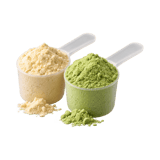
Keep the group 4 foods that do a job, like a protein shake that replaces a pastry, or a packaged whole wheat loaf with three times the fiber of white. “Ultra-processed” is one fact about a food, so check its protein, fiber and sugar too.
If you remember three things
- One ingredient decides it. If the label lists something a home kitchen doesn’t keep, like high-fructose corn syrup, whey protein or a flavoring, the food is ultra-processed. Sugar, salt and oil don’t count.
- It’s faster than full. In trials in three countries, people ate more or lost less weight on ultra-processed menus, and they ate them faster.
- Swap the staples, and judge the food too. Sandwiches, bakery, drinks, snacks and bread carry most of America’s ultra-processed calories. Some group 4 foods are still good choices.
The map
-
 1What makes a food ultra-processedOne question about the label
-
 2The four groupsAnd the foods that surprise people
-
 3Why it makes you eat moreThe trials, the speed and chewing
-
 4What the big studies foundDiabetes, heart disease and mood
-
 5Why it's never a gradeGroup 4 foods that went with less diabetes
-
 6How much is too muchAmerica's 53% and the 30% plate line
-
 7How to read a label in ten secondsOne lit word is enough
-
 8Additives with evidence in peopleEmulsifiers, sweeteners and colors
-
 9How to eat less of itOne staple a week
-
 10What changed in 2025 and 2026The rules, with dates
One ingredient a kitchen doesn’t keep
In 2009 Carlos Monteiro, a nutrition scientist at the University of São Paulo in Brazil, argued that the way food is processed says more about health than any single nutrient. His team’s system, NOVA, sorts every food into four groups by how it’s made. Researchers and the CDC use it, since the US has no official definition yet.
The test for the last group fits on the side of a box. Is there at least one ingredient a home kitchen doesn’t keep? That covers sugars like high-fructose corn syrup and maltodextrin, proteins like whey and soy protein isolate, hydrogenated oils, and the additives that change taste, color or texture, like flavorings, colors, emulsifiers, sweeteners and thickeners. Table sugar, salt, butter and oil are kitchen ingredients, however much of them there is.
One tomato, walked across the line
- 1Whole A tomato Washed and picked. Nothing added.
- 3Processed Canned tomatoes Add salt and put it in a can
- 3Processed Jarred tomato sauce Add olive oil and simmer
- 4Ultra-processed Ketchup Add high-fructose corn syrup and natural flavoring
- 4Ultra-processed A tomato-flavored chip Add starch, maltodextrin, color and flavoring, then fry
The test sorts some foods in ways people don’t expect. A three-ingredient whey powder is ultra-processed, because whey protein itself is on NOVA’s list. Dried pasta and frozen peas sit in the first group with plain oats. Most packaged sliced bread is in group 4, whole wheat included, while a loaf of flour, water, salt and yeast is only processed, even when a factory bakes it. What makes a food ultra-processed has the full test, the four groups has the surprises, and the label checker lights up the markers on a package in your hand.
Faster than full
In 2019 Kevin Hall’s team at the National Institutes of Health had 20 adults live on a research ward in Maryland for four weeks. For two weeks they ate ultra-processed meals, and for two weeks unprocessed ones, in random order. The menus offered the same calories, sugar, fat, fiber and salt, and people could eat as much or as little as they wanted.
On the ultra-processed menu they ate 508 more calories a day and gained about 2 pounds in two weeks. On the unprocessed menu they lost about 2 pounds. They rated the two menus about equally pleasant, and they didn’t report feeling hungrier on either. The clearest difference was speed, since they ate the ultra-processed meals 17 calories a minute faster. A ward in Tokyo and an 8-week trial in England have since found the same direction.
A glass of apple juice goes down in a few gulps, and the apples it came from would take you a while. In a 1977 study, ten people drank the juice eleven times faster than they ate the same apples, and felt less full after it. Breaking a food down makes it faster to eat, and a lot of ultra-processed food comes broken down already, like soft bread, puffed cereal and drinks.
Speed comes from texture more than from the label. In a 2022 study in Singapore, researchers served 50 adults four lunches, a soft and a hard version of a minimally processed meal and of an ultra-processed one.
Calories eaten a minute, four lunches in Singapore, 2022
People ate 789 calories of the soft ultra-processed lunch and 483 of the hard minimally processed one. Chewing works like a brake. Nobody knows yet how much of the effect is speed and how much is the density of calories, the flavors or the missing fiber, and why ultra-processed food makes you eat more goes through each idea. If it feels like you can’t stop at a few, is ultra-processed food addictive? has what the research says, and bodyfat.guide explains why a calorie is a calorie and still isn’t.
What it does to your health
The big studies say people who eat the most ultra-processed food get sick more often. A 2024 review in the BMJ pooled 45 analyses covering about 9.9 million people and found links with heart disease deaths, type 2 diabetes, anxiety, depression and early death. In November 2025 The Lancet published a series of three papers that drew on more than 100 long-term studies, trials and lab studies pointing the same way.
But most of those studies follow people and compare them, and people who eat a lot of ultra-processed food differ in many other ways. The BMJ reviewers rated 41 of the 45 results low or very low quality. The best supported link is type 2 diabetes, where each extra 10% of the diet from ultra-processed food went with about 12% more risk.
Feeding trials
84 people
Three trials, one to eight weeks each, food served and weighed. All three found more eaten or less weight lost on ultra-processed food.
Studies that follow people
9.9 million
45 pooled results in the 2024 BMJ review, each square one result, by how good the evidence was.
- Moderate 4
- Low 22
- Very low 19
- High 0
We’re confident that ultra-processed diets make people eat more, because trials in three countries found it. The evidence that they cause disease is thinner, and nobody knows yet which feature of the food does the harm. What the big studies found goes through it, with its own answers on diabetes, depression and weight.
Never a grade
In three big US studies of 198,636 adults, ultra-processed food as a whole went with more type 2 diabetes. Split by kind, the foods pointed in opposite directions.
Group 4 foods and type 2 diabetes, 198,636 US adults
Went with more diabetes
- Refined breads
- Sauces, spreads and condiments
- Sweetened and diet drinks
- Animal products, like processed meat
- Ready-to-eat mixed dishes
Went with less diabetes
- Breakfast cereals
- Dark and whole grain breads
- Packaged sweet and savory snacks
- Fruit-based products
- Yogurt and dairy desserts
In the England trial, people’s LDL cholesterol came out about 10 mg/dL lower on the ultra-processed diet. The group tells you how a food was made, and nutrition is a separate line, so this site shows the group, the share of calories and the protein, fiber and added sugar side by side, and never a processing score.
meals.guide frames it the same way. There, Processing is one of six checks on a plate’s grade, next to Energy, Muscle, Hunger, Nutrients and Glucose, and a plate clears it when no more than 30% of its calories are ultra-processed. A bowl of oatmeal and a banana clears Processing and still grades a C, because it’s short on protein. Processing on meals.guide has the plates, and processing isn’t the same thing as nutrition has the rest of the case.
Where it hides
US adults got 53.0% of their calories from ultra-processed food in 2021 to 2023, and children and teens 61.9%, by the CDC’s count.
Where US adults' calories come from
 Sandwiches, burgers included8.6%
 Sweet bakery5.2%
 Sweet drinks4.4%
 Savory snacks3.4%
 Bread, rolls and tortillas3.1%
- Everything else ultra-processed28.3%
No US guideline sets a share to stay under. The 2025 to 2030 Dietary Guidelines, published in January 2026, say to “avoid highly processed packaged, prepared, ready-to-eat, or other foods that are salty or sweet, such as chips, cookies, and candy”. They don’t define highly processed. We use meals.guide’s plate line, no more than 30% of a plate’s calories, as an everyday mark. How much is too much shows what a day under it looks like, and kids have their own page.
Swap the staples
The swap that does the most is the one you make in the cart, because a staple comes back every day. Here’s breakfast, worked with the same food table as the checker.
One swap at breakfast
- Cereal and milk220 calories, 10 g protein, 0.8 g fiber46%
-
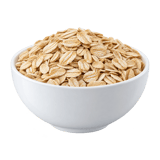 Oatmeal and milk270 calories, 14 g protein, 4 g fiber0%
The swap ladder does this for bread, cereal, yogurt, deli meat, peanut butter, snacks, drinks, plant milk and protein shakes, with the protein, fiber and added sugar on every rung. Keep the group 4 foods that do a job, like a gel on a long ride or a nutrition drink a doctor prescribed. How to eat less of it has the order to go in, and what it costs.
What changed in 2025 and 2026
- July 25, 2025. The FDA and USDA asked for input on a federal definition. Comments closed October 23, 2025.
- October 8, 2025. California’s AB 1264 became the first state law to define ultra-processed food, and it phases the most concerning ones out of school meals.
- November 18, 2025. The Lancet’s series argued that ultra-processed food is pushing out traditional diets and raising chronic disease worldwide.
- January 2026. The new Dietary Guidelines said to avoid highly processed salty and sweet food, and to limit artificial flavors, dyes, preservatives and low-calorie sweeteners.
- February 11, 2026. A federal court blocked Texas from enforcing a new warning label for 44 ingredients against the food industry groups that sued.
- August 10, 2026. HHS and USDA sent the first proposed federal definition to the White House for final review. As of November 15, 2026, its text hasn’t been published.
What changed in 2025 and 2026 has what each one does, and has the FDA defined ultra-processed food? answers the question people ask most.
Why are you here?
People come to ultra-processed food for a lot of different reasons. Weight, a scary headline, a snack they can’t put down, kids, a GLP-1, blood sugar, mood, a gut that feels off, a daily protein shake, a plant-based diet, a tight budget, a deli sandwich every day, or the news. Pick yours.
-
 I want to lose weightWhy people ate 508 more calories a day on it
- The headlines scared meWhat the big studies found, and how sure anyone is
-
 I can't stop at a fewIs it addictive, or just fast?
-
 My kids eat a lot of itAbout 62% of their calories, and the swaps that stick
-
 I'm on a GLP-1Which packaged foods to keep when you eat less
-
 My blood sugar is creeping upDiabetes risk, and the group 4 foods that went the other way
-
 My mood has been lowWhat the depression studies can and can't say
-
 My gut feels offEmulsifiers, the one small trial, and when to see a doctor
-
 I drink a protein shake every dayIt's group 4. Here's when that's fine
-
 I eat plant-basedPlant burgers, tofu and oat milk on the label test
-
 I'm on a budgetWhat the swaps cost, and the cheap ones
-
 I eat deli meat most daysProcessed meat and cancer, sized for one person
- I heard the rules changedThe federal definition, school meals and labels, dated
The numbers in one table
| The number | Where it’s from | |
|---|---|---|
| US adults’ share of calories from ultra-processed food | 53.0% (2021 to 2023) | CDC |
| Children and teens | 61.9% | CDC |
| Biggest single source | Sandwiches and burgers, 8.6% of adults’ calories | CDC |
| Extra eaten on the ultra-processed menu | 508 calories a day | NIH ward, 2019 |
| How much faster | 17 calories a minute | NIH ward, 2019 |
| Weight lost in 8 weeks | 2.06% minimally processed, 1.05% ultra-processed | England trial, 2025 |
| Everyday plate line | No more than 30% of a plate’s calories | meals.guide |
| US federal definition | None published as of November 15, 2026 | Federal Register |
The simple plan
Here’s how we’d run it, for anyone who wants to eat less ultra-processed food without making it a hobby.
- Start in your own kitchen. If you want to and can, cook dinner from raw ingredients a few nights a week, and pick the version you chew, like whole fruit over juice, oats over puffed cereal and a bakery loaf over soft sliced bread. That’s the whole idea, with no tool needed.
- Find your share once. The two-minute quiz works out about how much of a day like yours is ultra-processed and where it comes from, or build your own day in your day’s share. US adults average 53%.
- Check the five things you buy most. Bread, cereal, yogurt, a drink and a snack. Paste each ingredient list into the label checker. One lit word is enough for group 4.
- Swap one staple a week. Start with the one you eat most often and step it down a rung on the swap ladder. Five staples take five weeks, and each one repeats every time you shop.
- Keep the ones that do a job. A protein shake that replaces a pastry, a whole wheat loaf, a gel on a long ride. Judge them by protein, fiber and sugar, and grade the whole plate on meals.guide.
- Track it for a few weeks. Photograph your meals so you can see what you actually ate, rather than what you remember eating.
- Check again at eight weeks. That’s how long the England trial ran. Redo the quiz or your day’s share and see where the swaps took you.
18 sources
- Monteiro, Nutrition and health. The issue is not food, nor nutrients, so much as processing, Public Health Nutrition, 2009pubmed.ncbi.nlm.nih.gov
- Monteiro et al., Ultra-processed foods: what they are and how to identify them, Public Health Nutrition, 2019pmc.ncbi.nlm.nih.gov
- Hall et al., Ultra-processed diets cause excess calorie intake and weight gain: an inpatient randomized controlled trial of ad libitum food intake, Cell Metabolism, 2019pmc.ncbi.nlm.nih.gov
- Hamano et al., Ultra-processed foods cause weight gain and increased energy intake associated with reduced chewing frequency: a randomized, open-label, crossover study, Diabetes, Obesity and Metabolism, 2024pubmed.ncbi.nlm.nih.gov
- Dicken et al., Ultraprocessed or minimally processed diets following healthy dietary guidelines on weight and cardiometabolic health: a randomized, crossover trial, Nature Medicine, 2025pmc.ncbi.nlm.nih.gov
- Teo et al., Texture-based differences in eating rate influence energy intake for minimally processed and ultra-processed meals, American Journal of Clinical Nutrition, 2022pmc.ncbi.nlm.nih.gov
- Haber et al., Depletion and disruption of dietary fibre. Effects on satiety, plasma-glucose, and serum-insulin, The Lancet, 1977pubmed.ncbi.nlm.nih.gov
- Lane et al., Ultra-processed food exposure and adverse health outcomes: umbrella review of epidemiological meta-analyses, BMJ, 2024pmc.ncbi.nlm.nih.gov
- Monteiro et al., Ultra-processed foods and human health: the main thesis and the evidence, The Lancet, published online November 18, 2025pubmed.ncbi.nlm.nih.gov
- Chen et al., Ultra-processed food consumption and risk of type 2 diabetes: three large prospective U.S. cohort studies, Diabetes Care, 2023pmc.ncbi.nlm.nih.gov
- Williams et al., Ultra-processed food consumption in youth and adults: United States, August 2021 to August 2023, NCHS Data Brief 536, 2025cdc.gov
- US Departments of Agriculture and Health and Human Services, Dietary Guidelines for Americans, 2025 to 2030, January 2026, p. 4cdn.realfood.gov
- FDA and USDA, Ultra-processed foods: request for information, Federal Register, July 25, 2025federalregister.gov
- Federal Register, documents mentioning ultra-processed, searched November 15, 2026federalregister.gov
- CNBC, HHS moves to tighten oversight of food ingredients as safety concerns mount, August 10, 2026cnbc.com
- Office of Governor Gavin Newsom, Governor Newsom signs first-in-the-nation law to ban ultra-processed foods from school lunches, October 8, 2025gov.ca.gov
- Covington, Court enjoins Texas SB 25 food label warning requirement, February 12, 2026cov.com
- meals.guide, Processing: is processed food bad for you?, November 15, 2026meals.guide