How do I eat less ultra-processed food?
Swap the packaged things you buy every week, one a week: the sandwich bread, the breakfast cereal, the drink, the snack. Each swap repeats every time you eat it, so four swaps in a month add up to hundreds of meals a year with no extra cooking.
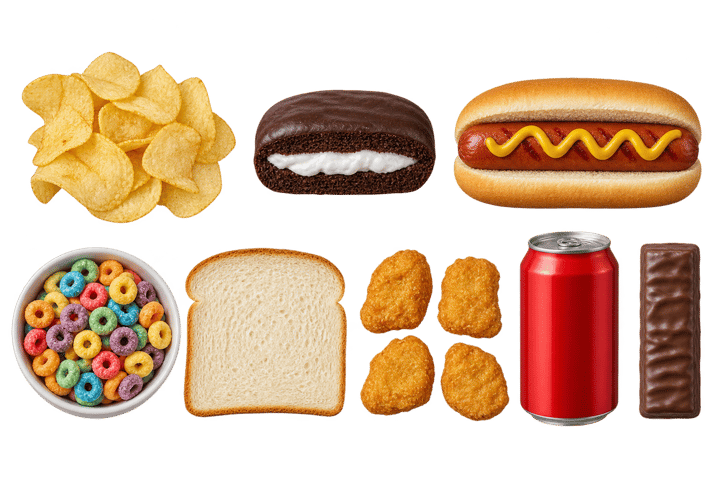
Most advice says to cook everything from scratch or shop only the edges of the store. The bigger problem is that it aims at the wrong foods. The biggest sources of ultra-processed calories for US adults aren’t exotic. They’re sandwiches and burgers, sweet baked goods, sweet drinks, savory snacks and bread (CDC, 2021 to 2023), and you buy most of those on autopilot.
We’d change the cart before the cooking. Pick the one packaged thing you eat most often, find the version with nothing on the label a kitchen wouldn’t keep, and buy that instead from now on. Next week, do the next one. Keep the food you’d miss most, and swap the ones you wouldn’t notice.
It’s like canceling subscriptions you forgot about. One cancellation saves money every month without you lifting a finger.
The swaps that move a day most
From the site’s checker and food table (USDA), at normal portions:
| Swap | Share of that meal’s calories from ultra-processed food | What else changes |
|---|---|---|
| Corn flakes and milk for oatmeal | 46% to 0% | Protein 10 g to 14 g, fiber 0.8 g to 4.0 g |
| Fruit yogurt for plain Greek yogurt and blueberries | 100% to 0% | Protein 10 g to 18 g, 90 fewer calories |
| Deli turkey for roast turkey on the same sandwich | 100% to 70% | Protein 14 g to 25 g |
| Wrapped cheese slices for cheddar | 100% to 0% | About the same |
| Soda for sparkling water | 100% to 0% | 152 fewer calories, 37 g less sugar |
The turkey sandwich stays at 70% because the bread is packaged whole wheat. That bread has about three times the fiber of white, so we’d keep it unless you can get a short-label loaf.
Run it as a test
In a 2025 trial in England, 50 adults ate a minimally processed diet for 8 weeks and an ultra-processed one for 8 weeks, both built to the UK’s healthy eating guide. They lost 2.06% of their weight on the first and 1.05% on the second, and cravings fell only on the minimally processed diet. You can run a home version: swap your staples for eight weeks and watch your weight and your hunger.
What we’d keep
Not every group 4 food needs to go. Packaged whole wheat bread, a protein shake in place of a pastry, an energy gel on a long ride and a nutrition drink your doctor prescribed all do a job. Frozen vegetables, canned beans, dried pasta, plain yogurt and cheese aren’t ultra-processed at all.
What we’d do
- Find your top three swaps in the two-minute quiz.
- Climb one staple a week in the swap ladder.
- Log your meals for a week to see what changed. Tracking it in Gyroscope shows how.
5 sources
- Williams et al., Ultra-processed food consumption in youth and adults: United States, August 2021 to August 2023, NCHS Data Brief 536, 2025cdc.gov
- Dicken et al., Ultraprocessed or minimally processed diets following healthy dietary guidelines on weight and cardiometabolic health: a randomized, crossover trial, Nature Medicine, 2025pmc.ncbi.nlm.nih.gov
- Monteiro et al., NOVA. The star shines bright, World Nutrition, 2016worldnutritionjournal.org
- Gebhardt and Thomas, Nutritive Value of Foods, USDA Home and Garden Bulletin 72, 2002ars.usda.gov
- USDA Standard Reference, Yogurt, Greek, plain, nonfat, the row in this site's food tablenutritionvalue.org