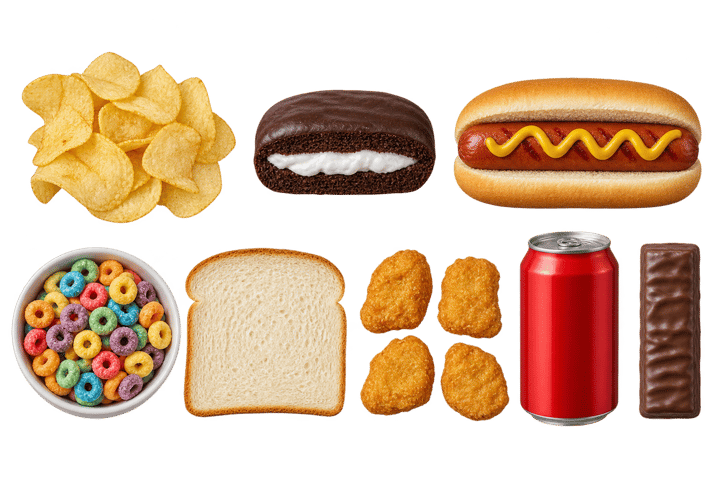
The swap ladder
Pick a staple you buy every week. Each rung down has one less thing a kitchen wouldn't keep, with its group, what decides it, and the nutrition per serving.

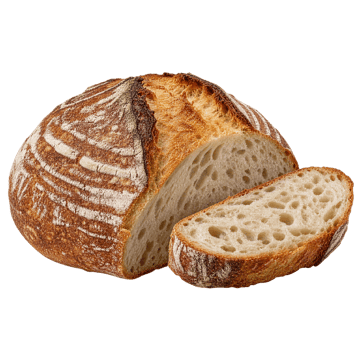
Sandwich bread, from ultra-processed down to whole

Packaged white bread2 slices
4Ultra-processedan emulsifier like mono- and diglycerides
134 cal, 4 g protein, 1.2 g fiber, 0 g added sugar

Packaged whole wheat2 slices
4Ultra-processedwheat gluten: a protein a kitchen doesn't make
138 cal, 6 g protein, 3.8 g fiber, 0 g added sugar
Same group as white, about three times the fiber.

Bakery sourdough2 slices
3ProcessedAdded: salt, a kitchen ingredient
138 cal, 4 g protein, 1.6 g fiber, 0 g added sugar
Flour, water and salt. Even a factory loaf like this is group 3.
Per serving as listed. Same group doesn't mean same food: compare the nutrition line under each one.
How to use it once
- Pick the staple you buy most often. For most people it's bread, cereal, yogurt or a drink.
- Step down one rung. Each rung has one less thing a kitchen wouldn't keep, and the group chip says where it lands.
- Check the line under it. If the lower rung costs you protein or fiber, the higher one may be the better food, and that's fine.
- Next week, do the next staple. Five staples take five weeks, and each swap repeats every time you shop.
Why staples first
One swap in the cart repeats every time you eat it. The bread, the cereal, the yogurt and the drink you buy every week carry more of a typical day than any treat, so they're where a swap moves your share most.
Not every rung is a better food
Packaged whole wheat and white bread are both group 4, and the whole wheat has about three times the fiber. A protein shake is group 4 too, and if it replaces a pastry it's still a good trade. The group tells you how a food is made. Read the nutrition line under it for what it brings.
What it costs
On the NIH ward, the ingredients for 2,000 calories a day cost $106 a week on the ultra-processed menu and $151 on the unprocessed one (Hall 2019, one supermarket chain). Oats, eggs, dried beans and frozen vegetables are the cheap rungs. We don't show prices per item yet.
3 sources
- Monteiro CA, Cannon G, Levy RB, et al. Ultra-processed foods: what they are and how to identify them. Public Health Nutrition, 2019pmc.ncbi.nlm.nih.gov
- Hall KD, Ayuketah A, Brychta R, et al. Ultra-processed diets cause excess calorie intake and weight gain: an inpatient randomized controlled trial of ad libitum food intake. Cell Metabolism, 2019pmc.ncbi.nlm.nih.gov
- Gebhardt SE, Thomas RG. Nutritive Value of Foods. USDA ARS, Home and Garden Bulletin 72, 2002ars.usda.gov
More tools
For adults looking at what they eat. It explains how food is made and doesn't grade your food or diagnose anything.