Processed vs ultra-processed food: what's the difference?
Processed food is a whole food with a kitchen ingredient added: cheddar is milk, cultures and salt, and canned beans are beans, water and salt. Ultra-processed food has at least one ingredient a home kitchen doesn’t keep, like whey protein, maltodextrin, an emulsifier or a flavoring. The ingredient list tells you which one you’re holding.
Most people use the two words as if they meant the same thing, and usually what they mean is “bad”. That puts frozen peas, canned beans and a block of cheddar on the same list as soda, and it makes eating less of it sound like cooking everything from scratch. The researchers who named ultra-processed food drew a much narrower line than that.
We’d stop worrying about processed food. Canning, cheesemaking and baking bread are all processing, and none of them makes a food ultra-processed. The kind to look for is the second one, above all in the packaged staples you buy every week.
Picture a home cook with a pantry of flour, salt, sugar, oil, vinegar and spices. Anything they can make from that pantry and whole food is processed at most. Ultra-processed food needs something they’d almost never cook with, like soy protein isolate, high-fructose corn syrup or mono- and diglycerides.
Where the line falls
Researchers sort food with a system called NOVA, from Carlos Monteiro’s team at the University of São Paulo. It puts every food in one of four groups by how it was made, and leaves nutrition out on purpose.
| Group | Our name | Examples |
|---|---|---|
| 1 | Whole or barely changed | Frozen peas, milk, plain yogurt, dried pasta, rolled oats |
| 2 | Kitchen ingredient | Salt, sugar, oil, butter, honey |
| 3 | Processed | Cheddar, canned beans, canned tuna, a loaf of flour, water, salt and yeast |
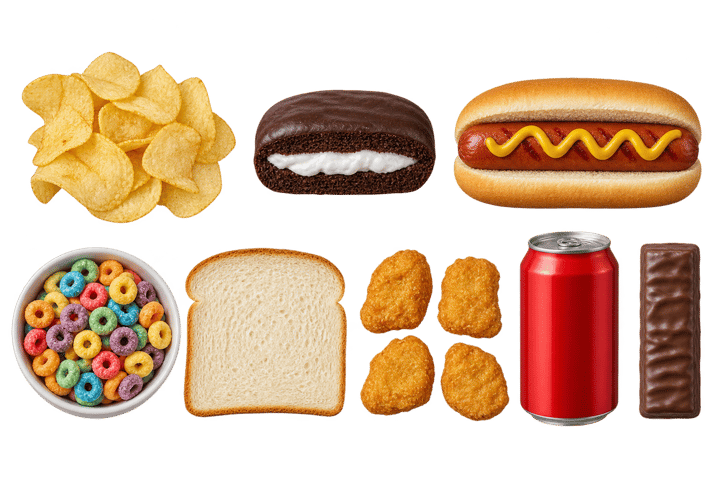
| 4 | Ultra-processed | Soda, fruit yogurt cups, protein powder, most packaged sliced bread |
The test for group 4 is one question about the label. Is there at least one ingredient of “no or rare culinary use”, or a cosmetic additive like a flavor, color, emulsifier, sweetener or thickener? Table sugar, salt and oil don’t count, however much of them there is. In 94 US sliced bread labels in Open Food Facts, 88 had at least one, most often wheat gluten.
The cheese aisle shows it best
A wedge of cheddar is milk, cultures, salt and an enzyme, so it’s group 3. Wrapped American slices melt into a smooth sheet because they’re made another way. The FDA’s own recipe for pasteurized process cheese requires an emulsifying agent, like sodium citrate or a phosphate salt, at up to 3% of the cheese’s weight. Emulsifying salts are on NOVA’s list, so every slice made to that recipe has a marker in it.
Watch the line move one ingredient at a time in one tomato, four groups, where a tomato turns into ketchup.
Which one to care about
The group says how a food was made, and it doesn’t say how good it is for you. In three US cohorts of 198,636 people, ultra-processed whole grain bread and yogurt went with lower diabetes risk, while sweet drinks and packaged meat products went with higher risk. Check the nutrition beside the group, and see why processing isn’t a grade.
US adults get 53.0% of their calories from ultra-processed food (CDC, 2021 to 2023), so that’s where the room to change is, and group 3 can stay.
What we’d do
- Keep the processed staples. Canned beans, canned tomatoes, cheese and a simple loaf are fine.
- Check the labels of what you buy every week for one ingredient a kitchen doesn’t keep. Paste one into the label checker.
- Look up a food or a whole plate in the checker.
6 sources
- Monteiro et al., Ultra-processed foods: what they are and how to identify them, Public Health Nutrition, 2019pmc.ncbi.nlm.nih.gov
- Monteiro et al., NOVA. The star shines bright, World Nutrition, 2016worldnutritionjournal.org
- US Food and Drug Administration, Pasteurized process cheese, 21 CFR 133.169ecfr.gov
- Open Food Facts, sliced breads sold in the United States, 94 ingredient lists checked with this site's label checker on November 14, 2026us.openfoodfacts.org
- Chen et al., Ultra-processed food consumption and risk of type 2 diabetes: three large prospective U.S. cohort studies, Diabetes Care, 2023pmc.ncbi.nlm.nih.gov
- Williams et al., Ultra-processed food consumption in youth and adults: United States, August 2021 to August 2023, NCHS Data Brief 536, 2025cdc.gov