What is ultra-processed food?
Ultra-processed food is food with at least one ingredient a home kitchen doesn’t keep: a sugar like maltodextrin or high-fructose corn syrup, a protein isolate like whey, a hydrogenated oil, or a flavoring, color, emulsifier, sweetener or thickener. One of them on the label is enough.
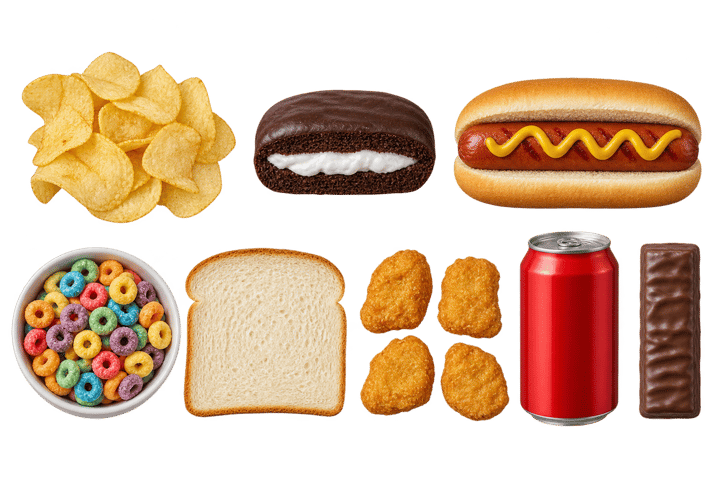
Most people picture junk food: soda, candy, chips. Those count, but the bigger share of it is in food that looks ordinary. For US adults, sandwiches and burgers carry more ultra-processed calories than soda does, 8.6% of all calories against 4.4% (CDC, 2021 to 2023). The bread, the sandwich meat and the flavored yogurt are where a lot of it hides.
We’d treat “ultra-processed” as a fact about how a food was made, and use it to pick between two versions of something you already eat. The packaged staples you buy every week are where one swap repeats the most times.
A tomato is one thing. A tomato-flavored chip is five or six things: potato starch, oil, maltodextrin, tomato powder, flavoring and color, built back into something that tastes like a tomato, and that’s the idea behind the term.
Where the word comes from
Carlos Monteiro’s team at the University of São Paulo built a system called NOVA that sorts food by how it’s made. Their 2019 paper calls ultra-processed foods “formulations of ingredients, mostly of exclusive industrial use”, and gives the practical test: check whether the ingredient list “contains at least one item characteristic of the ultra-processed food group”.
Those items come in two kinds:
| Kind | Examples from NOVA’s list |
|---|---|
| Food substances kitchens rarely use | High-fructose corn syrup, maltodextrin, dextrose, invert sugar, fruit juice concentrate, hydrogenated oils, whey protein, casein, soy protein isolate, gluten, hydrolyzed proteins |
| Cosmetic additives | Flavors, flavor enhancers, colors, emulsifiers, emulsifying salts, sweeteners, thickeners, and glazing and anti-foaming agents |
Sugar, salt, oil and butter aren’t on it. Neither are preservatives on their own, since NOVA’s authors allow them in processed foods too, like dried salted meat.
What it looks like in a store
NOVA’s authors list the typical ones: soft drinks, packaged snacks, candy, ice cream, mass-produced packaged bread, breakfast cereals, flavored yogurts, nuggets, sausages and hot dogs, instant noodles and soups. Plain frozen vegetables, dried pasta, plain yogurt and milk are on the other end, in group 1.
Why anyone cares
On a research ward at the US National Institutes of Health in 2019, 20 adults spent two weeks on an ultra-processed menu and two weeks on an unprocessed one. Both menus offered the same calories, sugar, fat, fiber and salt, and people could eat as much as they liked. They ate 508 more calories a day on the ultra-processed menu and gained about 2 pounds (0.9 kg). The whole story is in why ultra-processed food makes you eat more.
What we’d do
- Paste a label from your cupboard into the label checker. The ingredients a kitchen doesn’t keep light up.
- Check a meal in the checker, which shows the swap that drops its share most.
- Find your own share in the two-minute quiz.
4 sources
- Monteiro et al., Ultra-processed foods: what they are and how to identify them, Public Health Nutrition, 2019pmc.ncbi.nlm.nih.gov
- Monteiro et al., NOVA. The star shines bright, World Nutrition, 2016worldnutritionjournal.org
- Williams et al., Ultra-processed food consumption in youth and adults: United States, August 2021 to August 2023, NCHS Data Brief 536, 2025cdc.gov
- Hall et al., Ultra-processed diets cause excess calorie intake and weight gain: an inpatient randomized controlled trial of ad libitum food intake, Cell Metabolism, 2019pmc.ncbi.nlm.nih.gov