Why ultra-processed food makes you eat more
On this page
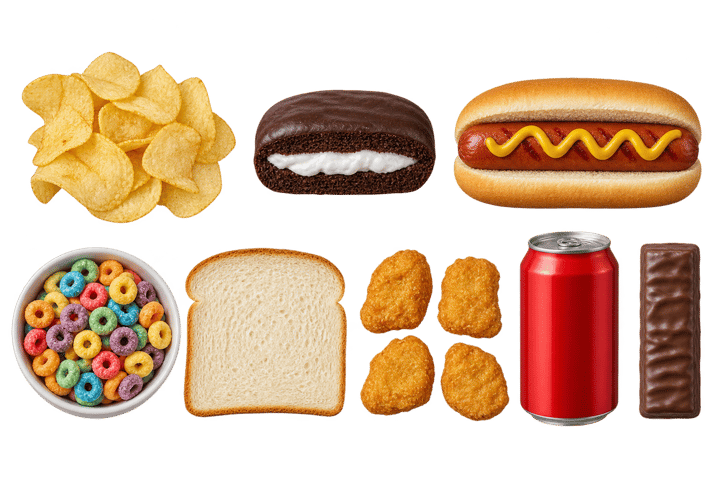
Ultra-processed food tends to be soft, dense and quick to eat, so more of it goes down before your body registers that you’re full. On a US government research ward in 2019, people ate 508 more calories a day on ultra-processed meals than on unprocessed ones, with sugar, fat, fiber and salt matched on paper.
What we’d do
Pick food you have to chew. Swap the soft, dense things you eat most often, the sandwich bread, the cereal, the salty snack and the sweet drink, for versions with more texture and more water in them. Don’t rely on the nutrition label to protect you, since the NIH menus matched on paper and still produced a 508 calorie gap, and don’t count on willpower to stop halfway through food that’s built to go down fast.
If you remember three things
- Three trials, three countries, the same result. People ate more or lost less weight on ultra-processed menus in the US, Japan and England.
- Speed is the best lead. People ate ultra-processed meals 17 calories a minute faster, and a harder lunch cut intake by about 300 calories.
- Nobody knows which feature does it. Softness, density, flavor and protein all have evidence, and no trial has pulled them apart.
Twenty people, two menus
Twenty adults, 10 men and 10 women, checked into the NIH Clinical Center in Bethesda, Maryland, for four weeks, in a study run by Kevin Hall’s team at the National Institutes of Health. Each person spent two weeks on an ultra-processed menu and two weeks on an unprocessed one, in random order.
The team designed the two menus to offer the same calories, the same calories per gram, and the same protein, carbs, fat, sugar, fiber and salt. Then they let people eat as much or as little as they wanted, with up to an hour for each meal, and measured what they ate.
On the ultra-processed weeks people ate 508 calories a day more, about 280 of them from carbs and 230 from fat, while protein didn’t change. They gained about 2 pounds (0.9 kg). On the unprocessed weeks they lost about 2 pounds. The 508 calories weren’t explained by taste, since people rated the two menus about equally pleasant and equally familiar, and they didn’t report feeling any hungrier on one menu than the other.
They did eat faster. The ultra-processed meals went down 17 calories a minute faster, and 7.4 g of food a minute faster.

How it works
Think of an apple and a glass of apple juice. The apple takes a few minutes of biting and chewing, and by the time it’s gone your stomach and gut have started telling your brain that food has arrived. The juice is gone in seconds, before any of that has started. Ultra-processed food tends to sit closer to the juice end of that line, even when it’s solid.
- It’s soft. Hall’s team suggested the ultra-processed foods were softer and easier to chew and swallow. In the Tokyo trial, men chewed less for every calorie on their ultra-processed week.
- Soft food goes down faster. Less chewing means more food per minute. On the NIH ward that was 17 calories a minute more, and in a Singapore lunch study, harder meals were eaten more slowly, with 26% fewer calories eaten.
- It’s dense. Food with less water and fiber in it carries more calories in each bite. On the NIH menus, the solid food on the ultra-processed side had about 85% more calories per gram than the solid food on the unprocessed side.
- Fullness lags. The signals that you’ve eaten come from your stomach stretching and from hormones your gut releases as food arrives. On the unprocessed menu, Hall’s team found more PYY, a gut hormone that tells your brain you’ve eaten, and less ghrelin, the hormone that makes you hungry.
- The calories pile up before the signals arrive. Across 2,733 meals on the NIH ward, the meals that were denser, eaten faster or built from very tasty food combinations were the ones people ate more of.
Each of these goes with eating more, but the trials changed all of them at once, so nobody can say yet how much each one adds.
The proof
The NIH ward, United States
20 adults, 2 weeks on each menu, in random order. Hall and colleagues, 2019
They ate 508 more calories a day on the ultra-processed menu and gained about 2 pounds, then lost about 2 pounds on the unprocessed menu. They ate 17 calories a minute faster.
Small and short, and people couldn’t choose their meals. The authors say the study wasn’t designed to find the cause.
The Tokyo ward, Japan
9 men with overweight or obesity, 1 week on each menu, at the University of Tokyo Hospital. Hamano and colleagues, 2024
They ate 813 more calories a day on the ultra-processed week and gained 2.4 pounds (1.1 kg) more. They chewed less for every calorie.
Nine men for one week each. The menus were matched for calories and the big nutrients.
The England trial
55 adults with overweight or obesity, 8 weeks on each diet, with all their food provided. Dicken and colleagues, 2025
Both diets followed the UK’s healthy eating guide. People lost 2.06% of their weight on the minimally processed diet and 1.05% on the ultra-processed one, and their cravings eased only on the minimally processed diet.
Most were women, and 43 finished both diets. People lost weight on both.
Hard and soft lunches, Singapore
50 healthy-weight adults, four lunches matched for calories served. Teo and colleagues, 2022
The soft ultra-processed lunch came to 789 calories eaten and the hard minimally processed one to 483, about 300 apart. Harder meals were eaten more slowly.
One meal each, in young, lean adults.
Every meal on the ward
2,733 meals from four NIH ward diets. Fazzino, Courville, Guo and Hall, 2023
Denser food, faster eating and very tasty food combinations each went with more calories eaten at a meal, on every diet.
It looked back at meals already served, so it can’t prove cause.
We’re confident that people eat more on ultra-processed menus in the short run. Three controlled trials found it, in three countries, with very different people and foods. The evidence for why is good but thinner. Eating speed and calories per bite have the most behind them, and the authors of a 2025 Lancet review name high calorie density, very tasty food, soft texture and broken-down food structure as the drivers of overeating.
The best case against it
Critics make three points.
The NIH menus weren’t matched the way the headline says. The two menus offered the same calories per gram only when drinks were counted. The ultra-processed meals were low in fiber, so the team dissolved fiber supplements in drinks to match it, and the solid food on that side was about 85% denser. On this view, density did the work, and “ultra-processed” is just a label on dense food. But the low fiber that forced the supplements came from the ultra-processed foods themselves, so the density was part of what the menu was testing. And the England trial, with both diets built to the same healthy eating guide, went the same way.
It’s just that the food tastes better. That would make sense, but the NIH volunteers rated the two menus about equally pleasant. The 2023 analysis of ward meals did find that very tasty food combinations went with eating more, so flavor is likely part of it, alongside speed.
The trials are small and short. That’s true. The biggest had 55 people, and the longest ran 8 weeks on each diet. Nobody has run a trial long enough to show the gap lasts for years. Hall’s team also suggested that people may keep eating until they’ve had enough protein, which could explain part of the gap.
Who it doesn’t apply to
If you’re trying to eat more, the same features help. During long endurance sessions, a gel or a sports drink is group 4, and it does a job that a chewy meal can’t. If a small appetite makes it hard to eat enough, food that goes down easily isn’t a problem to fix, and if you have a condition that limits what you can eat, keep to the plan your doctor or dietitian gave you.
Test it on yourself
- Find your soft staples. Take the quiz or pick your usual day in your day’s share, and note which foods carry the most ultra-processed calories.
- Swap three of them for food you chew. Oatmeal for cereal, bakery sourdough or a corn tortilla for packaged bread, air-popped popcorn or almonds for chips. The swap ladder has more.
- Eat as much as you want for two weeks. Don’t count anything. That’s how the trials ran.
- Weigh yourself on the same morning each week. On the NIH ward people lost about 2 pounds in two weeks on the unprocessed menu, and one weigh-in can swing more than that, so compare the averages of a few mornings.
The three trials side by side
| Trial | Where | Who | How long on each diet | What changed on ultra-processed food |
|---|---|---|---|---|
| Hall, 2019 | NIH ward, Maryland | 20 adults | 2 weeks | 508 calories a day more eaten, about 2 lb gained |
| Hamano, 2024 | University of Tokyo Hospital | 9 men | 1 week | 813 calories a day more eaten, 2.4 lb more gained |
| Dicken, 2025 | England, food provided | 55 adults | 8 weeks | About half the weight loss (1.05% against 2.06%) |
How the extra calories add up is on bodyfat.guide, in is a calorie just a calorie? and how to eat less without being hungry.
6 sources
- Hall et al., Ultra-processed diets cause excess calorie intake and weight gain: an inpatient randomized controlled trial of ad libitum food intake, Cell Metabolism, 2019pmc.ncbi.nlm.nih.gov
- Hamano et al., Ultra-processed foods cause weight gain and increased energy intake associated with reduced chewing frequency: a randomized, open-label, crossover study, Diabetes, Obesity and Metabolism, 2024pubmed.ncbi.nlm.nih.gov
- Dicken et al., Ultraprocessed or minimally processed diets following healthy dietary guidelines on weight and cardiometabolic health: a randomized, crossover trial, Nature Medicine, 2025pmc.ncbi.nlm.nih.gov
- Teo et al., Texture-based differences in eating rate influence energy intake for minimally processed and ultra-processed meals, American Journal of Clinical Nutrition, 2022pmc.ncbi.nlm.nih.gov
- Fazzino, Courville, Guo and Hall, Ad libitum meal energy intake is positively influenced by energy density, eating rate and hyper-palatable food across four dietary patterns, Nature Food, 2023pubmed.ncbi.nlm.nih.gov
- Monteiro et al., Ultra-processed foods and human health: the main thesis and the evidence, The Lancet, 2025pubmed.ncbi.nlm.nih.gov