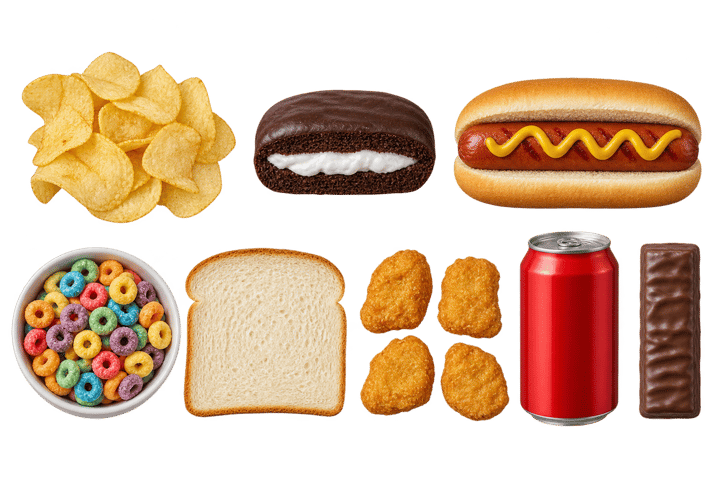
What the big studies found, and what they can't tell you
On this page
In big studies that follow people for years, those who eat the most ultra-processed food have more heart disease deaths, type 2 diabetes, anxiety and depression, and die earlier. Most of that evidence comes from comparing people, the experts who graded it rated most of it low or very low quality, and group 4 lumps very different foods together.
What we’d do
Act on the trials, and keep the big study numbers in proportion. The trials show ultra-processed menus make people eat more, which is reason enough to cut the sweet drinks, processed meat, refined bread and ready meals first. Those are also the foods that look worst in the big studies. A whole grain loaf or a yogurt cup looked fine or better in the same data, so there’s no need to fear them because they share a group.
If you remember three things
- The links are consistent, and mostly from weaker evidence. Of 45 pooled analyses, 4 were rated moderate quality and the rest low or very low.
- The foods inside group 4 point different ways. Sweet drinks and processed meat went with more type 2 diabetes, and whole grain bread and yogurt with less.
- Processed meat has its own cancer finding. Each 50 g eaten daily raised colorectal cancer risk by 18%, a rise in relative terms.
Why the headlines sound scarier than the studies
Most headlines about ultra-processed food and disease come from cohort studies. Researchers ask tens of thousands of people what they eat, follow them for years, and then compare the people who ate the most ultra-processed food with the people who ate the least. If the top group gets sick more often, that’s the finding.
A cohort can follow huge numbers of people for a long time, which no feeding trial can do. But it can’t hand anyone a menu. The people in the top group differ from the bottom group in a lot of ways besides their food, and the study has to try to adjust for each one.
You can see one of those differences in the CDC’s own numbers. US adults in families under 130% of the poverty line got 54.7% of their calories from ultra-processed food in 2021 to 2023, and those at 350% and above got 50.4%. Income goes with health in many ways that have nothing to do with a label, so every cohort has to untangle it.
What the big studies found
In 2024 a team led by Melissa Lane pulled together every pooled analysis they could find, 45 of them, covering 9,888,373 people. Higher ultra-processed food intake went with 32 of the 45 health outcomes they looked at. They graded each one by how strong the pattern looked and by GRADE, the system researchers use to rate how much to trust a body of evidence.
| Outcome | How much higher in the top eaters | Evidence quality (GRADE) |
|---|---|---|
| Death from cardiovascular disease | 50% higher risk (risk ratio 1.50) | Very low |
| Type 2 diabetes | 12% higher for each step up in intake (dose response 1.12) | Moderate |
| Anxiety | 48% higher odds (odds ratio 1.48) | Low |
| Common mental disorders | 53% higher odds (odds ratio 1.53) | Low |
| Obesity | 55% higher odds (odds ratio 1.55) | Low |
| Death from any cause | 21% higher risk (risk ratio 1.21) | Low |
Across all 45, four were rated moderate quality, 22 low and 19 very low. The diabetes finding is the best supported, and a 2023 analysis of 415,554 people found each 10% more of the diet from ultra-processed food went with 12% higher risk of type 2 diabetes.
In November 2025 The Lancet published a three-paper series on ultra-processed food led by Carlos Monteiro, who created NOVA. The first paper says more than 100 prospective studies, meta-analyses, trials and lab studies support harm across nearly all organ systems. It’s the strongest statement of the case, written by the people who built the classification.
The foods inside group 4 point different ways
The most useful study for your shopping cart came out of three long-running US cohorts, the Nurses’ Health Study, the Nurses’ Health Study II and the Health Professionals Follow-up Study. Together they followed 198,636 people, and 19,503 of them developed type 2 diabetes. People in the top fifth for ultra-processed food had 46% higher risk than the bottom fifth.
Then the researchers split group 4 into its parts.
| Went with higher diabetes risk | Went with lower diabetes risk |
|---|---|
| Refined breads | Breakfast cereals |
| Sauces, spreads and condiments | Dark and whole grain breads |
| Sugar-sweetened and artificially sweetened drinks | Packaged sweet and savory snacks |
| Animal-based products, like processed meat | Fruit-based products |
| Ready-to-eat mixed dishes | Yogurt and dairy-based desserts |
Both columns are in group 4, and they point in opposite directions. Part of that may be the people, since someone who eats whole grain cereal every morning may live differently from someone who drinks soda every afternoon. Part of it is the food. Group 4 holds both a fiber-rich loaf and a can of cola, and a number for “ultra-processed food” averages them together. Processing isn’t the same thing as nutrition has more on this.

Processed meat
Processed meat has its own finding, from 2015. That October, 22 experts from 10 countries, meeting for the International Agency for Research on Cancer, classified processed meat as carcinogenic to humans, for colorectal cancer. They found that each 50 gram portion (about 1.8 ounces) eaten daily raises the risk of colorectal cancer by 18%.
The World Health Organization defines processed meat as meat transformed through salting, curing, fermentation, smoking or other processes to add flavor or keep it longer, such as hot dogs, ham, sausages, corned beef and beef jerky.
An 18% rise is relative. It describes a change on top of the risk a person already has, and about 3.9% of American men and women are diagnosed with colorectal cancer at some point in their lives, by the National Cancer Institute’s figures. IARC itself said that for any one person the risk stays small and grows with the amount eaten. Eat processed meat less often and in smaller amounts. The swap ladder has roast turkey and canned tuna in place of deli meat.
The cancer finding cuts across NOVA’s groups. NOVA puts cured meats like ham and bacon in group 3 and hot dogs and sausages in group 4, and IARC counts all of them as processed meat.
What the trials add, and what they can’t
No one can run a feeding trial for 20 years to see who gets cancer or heart disease. The trials measure what they can in weeks: how much people eat, their weight and their blood.
On the NIH ward in 2019, people ate 508 more calories a day on the ultra-processed menu and gained about 2 pounds in two weeks. In the 8-week England trial in 2025, people lost more weight and more fat on minimally processed food, and their triglycerides fell more. But their LDL cholesterol fell more on the ultra-processed diet, by about 10 mg/dL, and both diets followed the UK’s healthy eating guide.
Extra calories eaten day after day add up to weight gain, and that’s the most likely route from ultra-processed food to the diabetes and heart disease seen in the cohorts. Whether anything else about the food adds to it, like additives or the way the food is broken down, is still being studied. Additives covers the human evidence on those.
The best case against the big claims
Critics point to two problems. The first is the classification itself. In 2022, about 160 French food and nutrition specialists sorted 120 labeled products into NOVA groups and their agreement was low, a Fleiss’ kappa of 0.32, where 0 means no better than chance and 1 means everyone agreed every time. If experts can’t place foods the same way, the questionnaires behind the cohorts may sort them inconsistently too.
The second is the lumping. When the same group holds whole grain bread and soda, a single risk number for “ultra-processed food” can hide the foods that do harm behind the ones that don’t, or the reverse.
The Lancet authors answer that the evidence as a whole, across many countries and outcomes, supports their case. Sweet drinks and processed meat come out at the top of the risk table either way, and the US Dietary Guidelines say to avoid sugar-sweetened drinks and highly processed salty or sweet foods.
How sure we are
We’re confident that ultra-processed diets make people eat more, because controlled trials in three countries found it. The link with type 2 diabetes is the best supported of the disease links, rated moderate quality in the 2024 review. For heart disease, depression, anxiety and early death, the links show up again and again, but the evidence behind them is low or very low quality. Nobody knows yet how much of the harm comes from the processing itself and how much from the sugar, salt, refined starch and missing fiber that come with many of these foods.
This page describes studies of large groups of people. If you have a condition that limits what you can eat, follow the plan your doctor or dietitian gave you.
12 sources
- Lane et al., Ultra-processed food exposure and adverse health outcomes: umbrella review of epidemiological meta-analyses, BMJ, 2024pmc.ncbi.nlm.nih.gov
- Chen et al., Ultra-processed food consumption and risk of type 2 diabetes: three large prospective U.S. cohort studies, Diabetes Care, 2023pmc.ncbi.nlm.nih.gov
- Monteiro et al., Ultra-processed foods and human health: the main thesis and the evidence, The Lancet, 2025pubmed.ncbi.nlm.nih.gov
- Hall et al., Ultra-processed diets cause excess calorie intake and weight gain: an inpatient randomized controlled trial of ad libitum food intake, Cell Metabolism, 2019pmc.ncbi.nlm.nih.gov
- Dicken et al., Ultraprocessed or minimally processed diets following healthy dietary guidelines on weight and cardiometabolic health: a randomized, crossover trial, Nature Medicine, 2025pmc.ncbi.nlm.nih.gov
- Williams et al., Ultra-processed food consumption in youth and adults: United States, August 2021 to August 2023, NCHS Data Brief 536, 2025cdc.gov
- International Agency for Research on Cancer, IARC Monographs evaluate consumption of red meat and processed meat, Press Release 240, 2015iarc.who.int
- World Health Organization, Cancer: carcinogenicity of the consumption of red meat and processed meat, questions and answers, checked 2026-11-14who.int
- National Cancer Institute, SEER cancer stat facts: colorectal cancer, checked 2026-11-14seer.cancer.gov
- Monteiro et al., The UN Decade of Nutrition, the NOVA food classification and the trouble with ultra-processing, Public Health Nutrition, 2018pmc.ncbi.nlm.nih.gov
- Braesco et al., Ultra-processed foods: how functional is the NOVA system?, European Journal of Clinical Nutrition, 2022pmc.ncbi.nlm.nih.gov
- US Departments of Agriculture and Health and Human Services, Dietary Guidelines for Americans, 2025 to 2030cdn.realfood.gov