If it's ultra-processed, it's unhealthy
Short answerNot the way you think
On this page
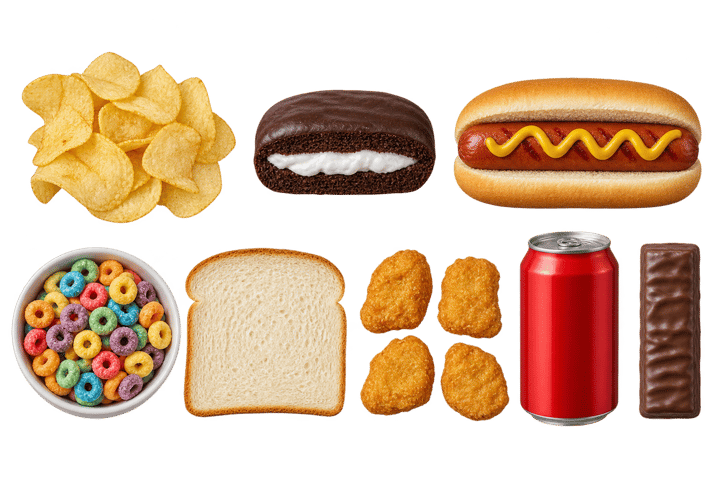
Not for every food in the group. A diet built mostly on ultra-processed food makes people eat more, and the big studies link it to more disease. But the group holds very different foods. In a study of 198,636 US adults, whole grain bread, breakfast cereal and yogurt went with lower type 2 diabetes risk, while sweet drinks and processed meat went with higher.
What we’d do
Treat a diet that’s mostly ultra-processed as a problem to fix, and treat single group 4 foods one by one. Drop the sweet drinks, processed meat and refined snacks first. Keep the group 4 foods that bring you fiber or protein you’d otherwise miss, like a packaged whole wheat loaf or a protein shake that replaces a pastry, until you find a version you like as much.
If you remember three things
- The pattern is the problem. On ultra-processed menus people ate 508 more calories a day in a ward trial.
- Single foods split both ways. Whole grain bread and yogurt went with less diabetes, and sweet drinks with more.
- The group can’t see nutrition. Packaged whole wheat has about three times the fiber of packaged white, and both are group 4.
Why people believe it
The headlines run together. Ultra-processed food is linked to heart disease, diabetes, depression and early death, and once a category gets a reputation like that, everything in it feels guilty. If a food has an emulsifier or a flavoring on the label, it must be bad for you.
The group was never meant as a health grade, though. NOVA sorts food by how it’s made. Whether a particular food is good for you depends on what’s in it and what it replaces.
The school and the student
A school with low average test scores still has students at the top of the class. The average tells you something real about the school, and you’d still look at the student before deciding anything. Ultra-processed food works the same way. The average across the group is unhealthy, and the foods inside it range from soda to fiber-rich bread.

What the big study found
Three long-running US cohorts, the Nurses’ Health Study, the Nurses’ Health Study II and the Health Professionals Follow-up Study, together followed 198,636 people, and 19,503 developed type 2 diabetes. People in the top fifth for ultra-processed food had 46% higher risk than those in the bottom fifth.
When the researchers split the group, it went both ways.
| Higher type 2 diabetes risk | Lower type 2 diabetes risk |
|---|---|
| Refined breads | Breakfast cereals |
| Sauces, spreads and condiments | Dark and whole grain breads |
| Sugar-sweetened and artificially sweetened drinks | Packaged sweet and savory snacks |
| Animal-based products, like processed meat | Fruit-based products |
| Ready-to-eat mixed dishes | Yogurt and dairy-based desserts |
This is a cohort study, so it can’t prove that cereal or yogurt protects anyone. People who eat yogurt every day may differ from people who drink soda every day. But it does show that “ultra-processed” as one number hides foods that point in opposite directions.
More foods where the group and the health don’t line up
- The LDL surprise. In a 2025 England trial, 55 adults lost more weight on 8 weeks of minimally processed food than on 8 weeks of ultra-processed food. Their LDL cholesterol, though, came out about 10 mg/dL lower on the ultra-processed diet.
- Bread. Two slices of packaged whole wheat have 3.8 g of fiber and 6 g of protein. Two slices of packaged white have 1.2 g and 4 g. Both are group 4 (USDA figures).
- Diet soda. It’s group 4 with almost no calories. A cola is group 4 with 152 calories and 36.8 g of sugar in 12 ounces.
- Whey protein. It’s group 4 by definition, because whey protein is on NOVA’s list of substances kitchens don’t use. A shake that replaces a pastry swaps one group 4 food for another and adds protein.
The best case for the belief
The strongest version goes like this. Even if some ultra-processed foods look fine on their own, a diet full of them makes people eat more. On the NIH ward in 2019, people ate 508 more calories a day on an ultra-processed menu that matched the unprocessed one on sugar, fat, fiber and salt. And a 2024 review of 45 pooled analyses, covering 9.9 million people, linked higher intake to 32 health outcomes, from heart disease deaths to depression.
All of that is true, and it’s why we’d cut ultra-processed food overall. But it’s about the diet as a whole. It doesn’t mean a slice of whole wheat bread is as bad as a can of soda.
What to do
- Cut first where the group and the nutrition agree: sweet drinks, processed meat, refined snacks and sweet bakery.
- Keep group 4 foods that bring fiber or protein, and look for a lower rung later.
- Judge by the nutrition beside the group. Every tool here shows protein, fiber and added sugar next to it, and the swap ladder shows when a swap would cost you fiber.
6 sources
- Chen et al., Ultra-processed food consumption and risk of type 2 diabetes: three large prospective U.S. cohort studies, Diabetes Care, 2023pmc.ncbi.nlm.nih.gov
- Dicken et al., Ultraprocessed or minimally processed diets following healthy dietary guidelines on weight and cardiometabolic health: a randomized, crossover trial, Nature Medicine, 2025pmc.ncbi.nlm.nih.gov
- Lane et al., Ultra-processed food exposure and adverse health outcomes: umbrella review of epidemiological meta-analyses, BMJ, 2024pmc.ncbi.nlm.nih.gov
- Hall et al., Ultra-processed diets cause excess calorie intake and weight gain: an inpatient randomized controlled trial of ad libitum food intake, Cell Metabolism, 2019pmc.ncbi.nlm.nih.gov
- Monteiro et al., Ultra-processed foods: what they are and how to identify them, Public Health Nutrition, 2019pmc.ncbi.nlm.nih.gov
- Gebhardt and Thomas, Nutritive Value of Foods, USDA Home and Garden Bulletin 72, 2002ars.usda.gov