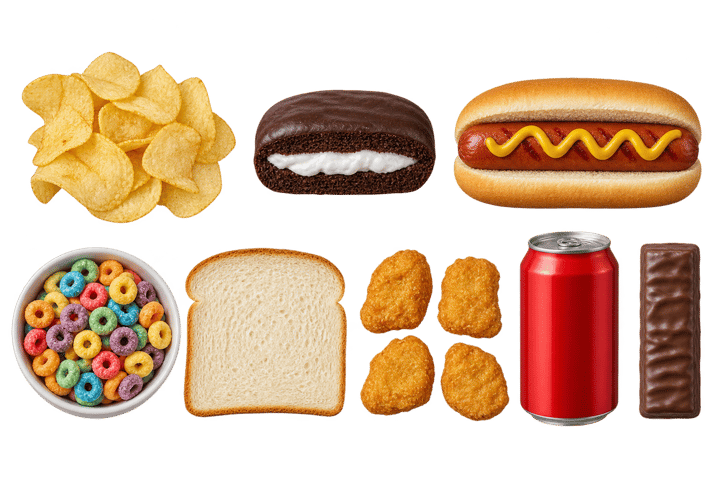
Is ultra-processed food really that bad?
On this page
Bad enough to change what you buy every week, and not so bad that every package is a threat. In three small controlled trials, people ate more or lost less weight on ultra-processed food. Huge studies link it to heart disease, type 2 diabetes and depression, but most of that evidence rates low quality, and the group mixes very different foods.
There are two loud camps. One says ultra-processed food is poison and blames it for almost everything. The other says the whole idea is a fad, since a calorie is a calorie and “processed” means nothing. The trials and the big studies support neither.
We’d treat it as a strong reason to swap your staples and a weak reason to worry about any single food. In the trials, people ate more of it when they could eat as much as they liked. The big studies lean the same way, with more noise. The foods inside the group behave differently, so a whole grain loaf and a soda shouldn’t get the same look.
It’s like living near a busy road. The effect shows up over years across a whole city, and it’s a good reason to pick the quieter street when you have the choice.
The trials
| Trial | Who | What happened |
|---|---|---|
| NIH ward, US, 2019 | 20 adults, 2 weeks on each menu | 508 more calories a day on the ultra-processed menu, about 2 pounds gained, against 2 pounds lost on the other |
| University of Tokyo Hospital, 2024 | 9 men with overweight, 1 week each | 813 more calories a day and 1.1 kg more weight on ultra-processed food |
| England, 2025 | 50 adults, 8 weeks on each diet, both built to the UK’s healthy eating guide | Weight loss of 2.06% on minimally processed food and 1.05% on ultra-processed |
None ran longer than 8 weeks on a diet, and none was built to show which part of the food does it. In the English trial people still lost weight on the ultra-processed diet, and their LDL cholesterol came out lower on it.
The big studies
In 2024, Lane and colleagues pooled 45 analyses covering 9,888,373 people. More ultra-processed food went with worse results on 32 of the 45 outcomes, including death from heart disease, type 2 diabetes, anxiety and common mental disorders. But these are all observational, and by the standard grading system, 4 of the analyses were moderate quality, 22 low and 19 very low.
Chen’s study of 198,636 US adults shows the second problem. Overall, the people eating the most ultra-processed food had more type 2 diabetes. Split it up and sweet drinks, refined bread and packaged meat went with more, while cereals, whole grain breads and yogurt went with less, though every one of them was ultra-processed.
What we’d do
- Swap the staples that carry the most group 4 calories, starting with sandwiches, sweet baked goods and sweet drinks. The swap ladder has them.
- Keep the group 4 foods that pull their weight, like whole wheat bread or yogurt.
- Find your own share in the two-minute quiz, and see what the big studies can’t tell you.
5 sources
- Hall et al., Ultra-processed diets cause excess calorie intake and weight gain: an inpatient randomized controlled trial of ad libitum food intake, Cell Metabolism, 2019pmc.ncbi.nlm.nih.gov
- Hamano et al., Ultra-processed foods cause weight gain and increased energy intake associated with reduced chewing frequency: a randomized, open-label, crossover study, Diabetes, Obesity and Metabolism, 2024pubmed.ncbi.nlm.nih.gov
- Dicken et al., Ultraprocessed or minimally processed diets following healthy dietary guidelines on weight and cardiometabolic health: a randomized, crossover trial, Nature Medicine, 2025pmc.ncbi.nlm.nih.gov
- Lane et al., Ultra-processed food exposure and adverse health outcomes: umbrella review of epidemiological meta-analyses, BMJ, 2024pmc.ncbi.nlm.nih.gov
- Chen et al., Ultra-processed food consumption and risk of type 2 diabetes: three large prospective U.S. cohort studies, Diabetes Care, 2023pmc.ncbi.nlm.nih.gov