Does ultra-processed food make you gain weight?
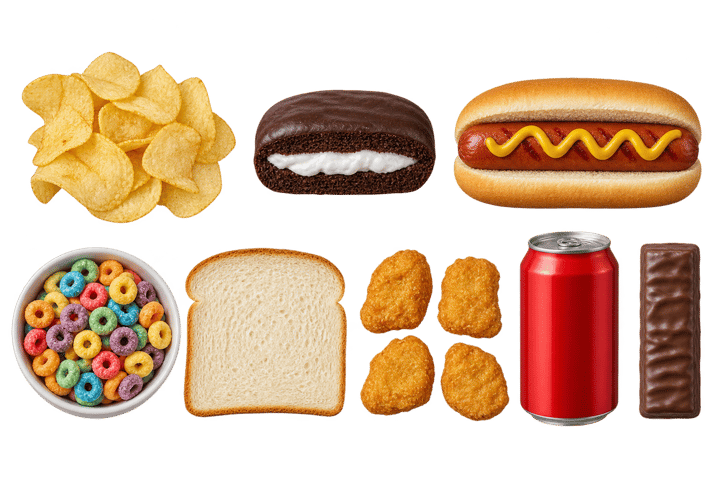
It makes people eat more, and the weight follows the calories. On a US research ward, adults ate 508 more calories a day on an ultra-processed menu and gained about 2 pounds in two weeks. In an 8-week trial in England, people lost weight on both diets, but only half as much on the ultra-processed one.
The usual story is that ultra-processed food is fattening because it’s full of sugar and fat. The NIH trial was set up to test exactly that. Both menus offered the same calories, sugar, fat, fiber and salt, and people still ate more of the ultra-processed one. Something about the food made it easier to eat a lot of it.
We’d use this as the main practical reason to eat less ultra-processed food if you’re trying to lose weight. In all three trials below, people could eat as much as they liked, and the kind of food alone changed how much they ate.
It’s like the difference between a buffet with a conveyor belt and one where you have to walk to the table. Same food on offer, and one of them makes it easy to keep going.
The three trials
The NIH ward, 2019. Kevin Hall’s team had 20 adults live at the NIH Clinical Center for four weeks: two weeks on each menu, in random order, eating as much or as little as they liked. On the ultra-processed menu they ate 508 calories a day more and gained 0.9 kg (about 2 pounds). On the unprocessed menu they lost about the same amount. They rated both menus about equally pleasant.
Tokyo, 2024. Nine men with overweight ate each menu for a week at the University of Tokyo Hospital. On ultra-processed food they ate 813 more calories a day and gained 1.1 kg more, and they chewed less per calorie.
England, 2025. 50 adults ate two diets for 8 weeks each, both built to the UK’s healthy eating guide and delivered to their homes. They lost 2.06% of their weight on the minimally processed diet and 1.05% on the ultra-processed one. Cravings fell only on the minimally processed diet.
What they can’t tell you
All three were short and small. None can say which feature of the food did it. The leading ideas are that soft, energy-dense food gets eaten faster, before fullness catches up, and that’s covered in why it’s so hard to stop eating.
The big observational studies agree with the direction. In a 2024 umbrella review of 45 pooled analyses, more ultra-processed food went with 1.55 times the odds of obesity, though the evidence was rated low quality.
Calories still decide the weight. The English trial shows you can lose weight on ultra-processed food, and that it went about half as fast. bodyfat.guide covers whether every calorie counts the same.
What we’d do
- Swap the foods you eat fastest, like soft bread, sweet drinks and snacks, for ones you have to chew.
- Start with breakfast or the drink, since one swap repeats every day.
- Find where your calories come from in the two-minute quiz.
4 sources
- Hall et al., Ultra-processed diets cause excess calorie intake and weight gain: an inpatient randomized controlled trial of ad libitum food intake, Cell Metabolism, 2019pmc.ncbi.nlm.nih.gov
- Hamano et al., Ultra-processed foods cause weight gain and increased energy intake associated with reduced chewing frequency: a randomized, open-label, crossover study, Diabetes, Obesity and Metabolism, 2024pubmed.ncbi.nlm.nih.gov
- Dicken et al., Ultraprocessed or minimally processed diets following healthy dietary guidelines on weight and cardiometabolic health: a randomized, crossover trial, Nature Medicine, 2025pmc.ncbi.nlm.nih.gov
- Lane et al., Ultra-processed food exposure and adverse health outcomes: umbrella review of epidemiological meta-analyses, BMJ, 2024pmc.ncbi.nlm.nih.gov