Is ultra-processed food addictive?
On this page
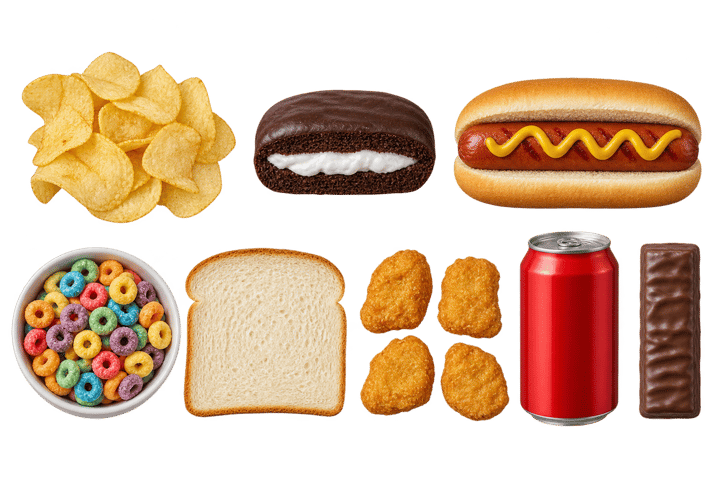
For some people it seems to act like it. Across 281 studies in 36 countries, about 14% of adults and 12% of children met the criteria on a food addiction questionnaire, close to the rate for alcohol. The foods people struggled with were mostly ultra-processed sweets and salty snacks. But nobody has shown that a food hooks the brain the way a drug does, and plain speed explains a lot of the overeating.
Some people hear “addictive” and feel let off the hook, since it’s the food’s fault. Others roll their eyes, since nobody has withdrawal from carrots. Both reactions treat addiction as yes or no. The research treats it as a pattern of eating that some people have, most don’t, and almost nobody has with plain vegetables.
We’d take it seriously for the people it describes, and plan around the food rather than willpower. If there’s one food you can’t stop at, don’t keep it in the house in a big bag, buy it in single servings, and swap your everyday version for something you have to chew. It’s much easier to skip a food that isn’t in the cupboard.
It’s like the difference between an apple and a glass of apple juice. Same sugar, but the juice arrives all at once. In a 1977 study, people drank apple juice eleven times faster than they ate the same apples, and felt less full after it.
What the questionnaire asks
Researchers at Yale built a food addiction scale by taking the 11 symptoms doctors use for alcohol and drug problems and asking them about food. Do you eat more than you meant to? Have you tried to cut down and failed? Do you keep eating it despite problems it causes? Someone counts as having food addiction with two or more symptoms in the past year, plus real distress or trouble in their life from it.
In a 2023 analysis in the BMJ, Ashley Gearhardt and her colleagues pooled the studies that used the scale. The rate was 14% in adults and 12% in children. For comparison, they cite rates of 14% for alcohol and 18% for tobacco.
Which foods people get stuck on
In 2015 the same team asked 120 students and then 384 adults online which foods they had trouble controlling.
| Most trouble | Least trouble |
|---|---|
| Pizza | Cucumbers |
| Chocolate | Carrots |
| Chips | Beans |
| Ice cream, fries and cookies | Apples, broccoli and water |
The researchers found that how processed a food was predicted the trouble best, along with how much fat it had and how fast its carbs hit the blood. Every food on the left is usually group 4. None on the right is.
Where the idea stops
The 14% comes from questionnaires, which measure how eating feels, and nobody has run a trial that shows a food causes addiction the way a drug does. Gearhardt’s team argue that refined carbs and fats raise dopamine in the brain to levels like nicotine and alcohol do, and that ultra-processed food delivers them faster. That’s their case, and other scientists still argue about whether “addiction” is the right word for food.
The NIH ward points at something plainer. People there rated the ultra-processed and unprocessed menus about equally pleasant, and they didn’t report feeling hungrier on either. They still ate 508 more calories a day of the ultra-processed one, 17 calories a minute faster. You don’t need a craving to overeat food that goes down that fast. Why ultra-processed food is so hard to stop eating has the speed studies.
What we’d do
- Name your one food. If there’s a food you can’t stop at, buy it in single servings, or not at all for a month.
- Swap the everyday version. The swap ladder has popcorn and almonds for chips, an apple for the granola bar, and oats for the cereal.
- Slow the snack down. Pick the version you have to chew, and put it in a bowl instead of eating from the bag.
- Get help if it’s more than a snack. If eating feels out of control most weeks, or you binge and then feel awful, talk to a doctor. The National Institute of Mental Health says eating disorders can be treated successfully.
5 sources
- Gearhardt et al., Social, clinical, and policy implications of ultra-processed food addiction, BMJ, 2023pmc.ncbi.nlm.nih.gov
- Schulte, Avena and Gearhardt, Which foods may be addictive? The roles of processing, fat content, and glycemic load, PLoS One, 2015pmc.ncbi.nlm.nih.gov
- Hall et al., Ultra-processed diets cause excess calorie intake and weight gain: an inpatient randomized controlled trial of ad libitum food intake, Cell Metabolism, 2019pmc.ncbi.nlm.nih.gov
- Haber et al., Depletion and disruption of dietary fibre. Effects on satiety, plasma-glucose, and serum-insulin, The Lancet, 1977pubmed.ncbi.nlm.nih.gov
- National Institute of Mental Health, Eating disordersnimh.nih.gov