Why is ultra-processed food so hard to stop eating?
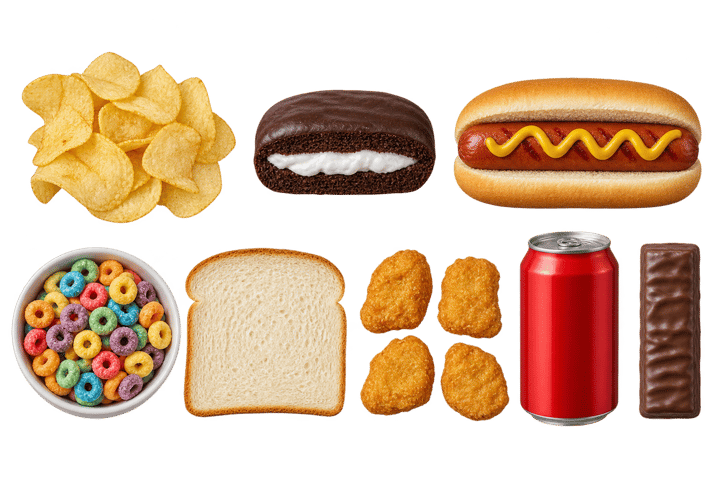
Because it’s soft, dense and quick to eat. On the NIH research ward, people ate ultra-processed meals 17 calories a minute faster than unprocessed ones, so more food got in before feeling full caught up with them. In a lunch study, harder food slowed people down and they ate about 300 fewer calories.
Most people blame themselves, or blame sugar and fat, or a company engineering food to be addictive. The trials point at something more ordinary. Food that needs little chewing goes down fast, and fullness takes time to arrive. The faster the food, the more of it you’ve eaten by then.
We’d pick the version of your staples that takes longer to eat. Whole fruit over juice, a crunchy apple over a granola bar, a chewy loaf over soft sliced bread, popcorn over chips. It’s the easiest change here, since you don’t have to cut anything out.
It’s like pouring a drink with a funnel versus a fire hose. Feeling full runs on a timer, and the soft food arrives before the timer goes off.
What the studies measured
| Study | What they found |
|---|---|
| NIH ward, 2019, 20 adults | Ultra-processed meals eaten 17 calories a minute faster (7.4 g a minute). 508 more calories a day overall |
| Singapore lunch study, 2022, 50 adults | Eating speed differed by 35% between hard and soft meals, and people ate 26% less energy from the hard ones. The soft ultra-processed lunch came to 789 calories, the hard minimally processed one to 483 |
| NIH meals analysis, 2023, 2,733 meals | Energy density, eating rate and very tasty food each went with more calories eaten at a meal, on all four diets |
| Tokyo, 2024, 9 men | Fewer chews per calorie on the ultra-processed week, and 813 more calories a day |
In the Singapore study, the texture changed how fast people ate whether the meal was ultra-processed or not. The authors concluded that eating rate and energy density “contribute to observed differences in energy intake” between the two kinds of food.
Where the model stops
None of these trials can say which feature counts most, or whether additives play a part as well. Speed and softness explain a lot of what was measured, and nobody has shown they explain all of it. The idea that ultra-processed food is engineered to be addictive is a claim about intent, and the trials didn’t test it.
The swaps that slow you down
| Fast | Slower | Calories |
|---|---|---|
| Potato chips, 1 oz | Air-popped popcorn, 3 cups | 152 to 93 |
| Granola bar | An apple | 134 to 81 |
| Corn flakes, 1 cup | Oatmeal, 1 cup | 102 to 145, with 4 g more protein |
From the site’s food table (USDA). The oatmeal has more calories than the flakes, and more protein (6 g against 2 g) and fiber (4 g against 0.8 g).
What we’d do
- Choose food you have to chew, at the meal you eat fastest.
- Put your fork down between bites if you notice you’re done before everyone else.
- Start with the snack in the swap ladder. bodyfat.guide covers hunger and fullness in more depth.
5 sources
- Hall et al., Ultra-processed diets cause excess calorie intake and weight gain: an inpatient randomized controlled trial of ad libitum food intake, Cell Metabolism, 2019pmc.ncbi.nlm.nih.gov
- Teo et al., Texture-based differences in eating rate influence energy intake for minimally processed and ultra-processed meals, American Journal of Clinical Nutrition, 2022pmc.ncbi.nlm.nih.gov
- Fazzino et al., Ad libitum meal energy intake is positively influenced by energy density, eating rate and hyper-palatable food across four dietary patterns, Nature Food, 2023pubmed.ncbi.nlm.nih.gov
- Hamano et al., Ultra-processed foods cause weight gain and increased energy intake associated with reduced chewing frequency: a randomized, open-label, crossover study, Diabetes, Obesity and Metabolism, 2024pubmed.ncbi.nlm.nih.gov
- Gebhardt and Thomas, Nutritive Value of Foods, USDA Home and Garden Bulletin 72, 2002ars.usda.gov