How much ultra-processed food is too much?
On this page
No US guideline sets a number. The 2025 to 2030 Dietary Guidelines say to avoid highly processed salty and sweet foods, and stop there. US adults get 53% of their calories from ultra-processed food. We use meals.guide’s plate line, 30%, as an everyday mark, and which foods make up your share counts more than the exact figure.
People want a number, like the guidelines’ line of less than 2,300 mg of sodium a day. Some articles quote “80/20” or “90% whole foods”, and neither comes from a US guideline. The new guidelines tell Americans to avoid highly processed food, and they still set no share of calories.
We’d skip chasing a percentage and go after the three or four group 4 foods that carry most of your share. For most people that’s the sandwich, the breakfast and the drink. Swap those and the number takes care of itself. If you like a mark to aim at, under 30% of a day’s calories is a day where most of what you ate had nothing on the label a kitchen wouldn’t keep.
Where Americans are
| Who | Share of calories from ultra-processed food |
|---|---|
| Adults 19 and up | 53.0% |
| Ages 19 to 39 | 54.4% |
| Ages 40 to 59 | 52.6% |
| 60 and up | 51.7% |
| Children and teens, 1 to 18 | 61.9% |
CDC, August 2021 to August 2023. The adult share fell from 55.8% in 2013 to 2014.
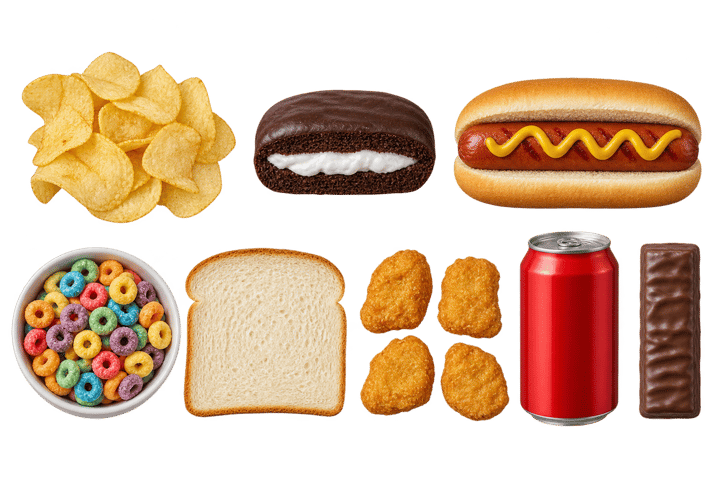
The five biggest sources for adults, as a share of all calories: sandwiches and burgers 8.6%, sweet bakery products 5.2%, sweetened drinks 4.4%, savory snacks 3.4%, and breads, rolls and tortillas 3.1%.
A typical day, worked
The quiz builds a day from five picks. Corn flakes and milk, a turkey sandwich, chicken with rice and broccoli, a cookie and a soda come to about 1,180 calories, and 55% of them are ultra-processed. The sandwich carries the most, 297 calories. Swap it for a chicken, rice and bean bowl and the same day comes to 26%, with protein up from about 68 g to 92 g and fiber from about 8 g to 13 g.
Why the foods count more than the share
In three US cohorts of 198,636 people, sweet drinks, refined bread and packaged meat went with more type 2 diabetes, while whole grain bread, cereals and yogurt went with less, all inside the same group. Two people at 40% can be eating very different things. The share is a useful way to see where your calories come from, and the foods in it are what to change.
What we’d do
- Find your share in the two-minute quiz, or log a day in your day’s share.
- Swap the biggest single source first. For most people it’s lunch.
- Keep the group 4 foods that do a job, like whole wheat bread or a protein shake in place of a pastry.
4 sources
- US Departments of Agriculture and Health and Human Services, Dietary Guidelines for Americans, 2025 to 2030cdn.realfood.gov
- Williams et al., Ultra-processed food consumption in youth and adults: United States, August 2021 to August 2023, NCHS Data Brief 536, 2025cdc.gov
- Chen et al., Ultra-processed food consumption and risk of type 2 diabetes: three large prospective U.S. cohort studies, Diabetes Care, 2023pmc.ncbi.nlm.nih.gov
- Gebhardt and Thomas, Nutritive Value of Foods, USDA Home and Garden Bulletin 72, 2002ars.usda.gov