The four groups, and the foods that surprise people
On this page
NOVA puts every food in one of four groups: whole or barely changed, kitchen ingredients, processed, and ultra-processed. The surprises are where people learn the rule. Whey protein, fruit yogurt and packaged sliced bread are group 4, and dried pasta, frozen peas and plain yogurt are group 1.
What we’d do
Learn the groups from the foods you already buy, and stop guessing from how healthy a food looks. Most of the whole foods in your freezer and pantry are fine as they are. The group 4 foods to swap first are the ones you eat every day, and the group tells you only how a food was made, so check its protein, fiber and added sugar before you decide anything.
If you remember three things
- Freezing, drying, canning and fermenting don’t make food ultra-processed. Frozen peas are group 1 and canned beans group 3.
- Health foods land in group 4 all the time. Whey powder, fruit yogurt and most packaged bread carry an ingredient a kitchen doesn’t keep.
- The group isn’t a score. It says how a food was made, and nothing about its protein, fiber or sugar.
Why the groups trip people up
People sort food by feel. Anything that tastes sweet, comes in a crinkly bag or has a cartoon on the box goes in the bad pile, and anything with “protein”, “whole grain” or a picture of a farm goes in the good one.
NOVA ignores all of that. It looks at what was done to the food and what was added, so a tub of whey protein and a can of soda end up in the same group, and a bag of frozen peas ends up with fresh ones. Once you see why, you can sort almost anything in your kitchen yourself.
Group 1: whole or barely changed
The food itself, with only what NOVA’s authors list as minimal processes done to it: removing the parts you don’t eat, drying, crushing, grinding, roasting, boiling, pasteurizing, chilling, freezing, putting it in a container or vacuum pack, and fermenting without alcohol.
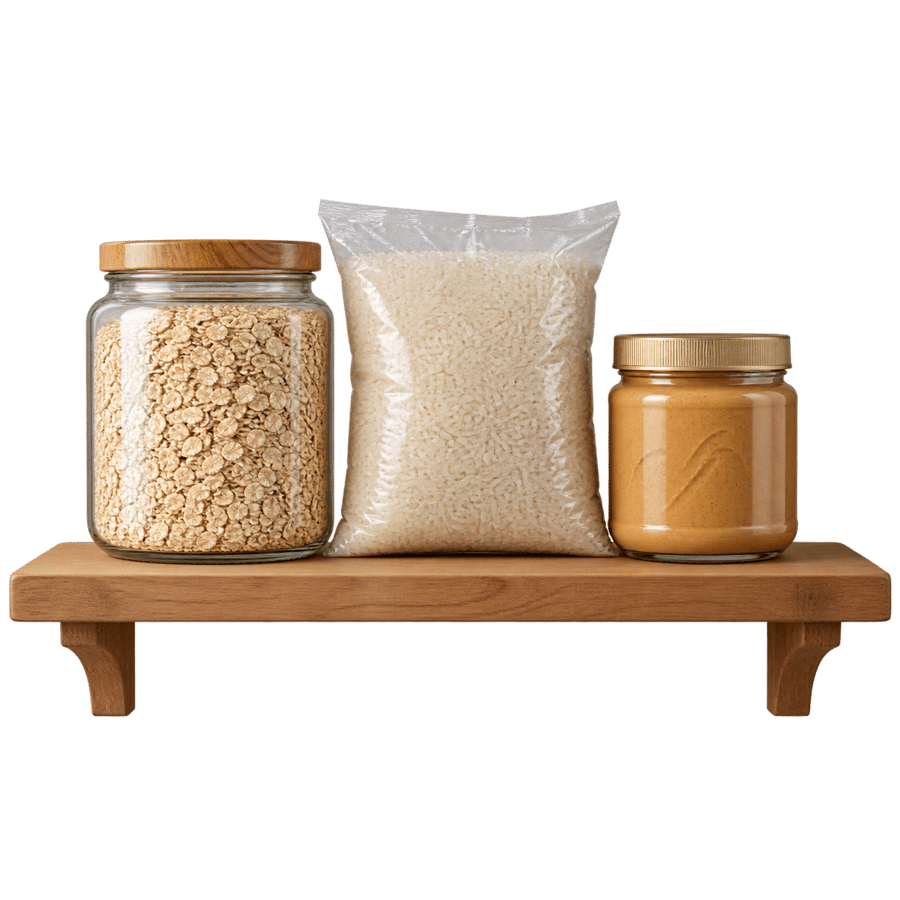
That covers fresh and frozen vegetables and fruit, plain oats and rice, beans and lentils from the bag, nuts, eggs, milk, fresh meat and fish, and coffee and tea. Two foods surprise people here. The 2018 NOVA paper names pasta made only of flour and water as group 1, and plain yogurt with no added sugar or sweetener too.
Group 2: kitchen ingredients
Things you cook group 1 food with, taken from foods or from nature: salt, sugar, honey, butter, lard, and oils like olive, canola and corn oil. Nobody eats a bowl of them on their own.
This group surprises people more than any other. Table sugar and every cooking oil sit here, beside olive oil and butter. NOVA’s authors say plant oils, sugar and salt, as used in cooking, aren’t ultra-processed, which describes how they’re made and used. How much of them to eat is a separate question, and the sugar myth and the seed oil myth take each one apart.
Group 3: processed
A group 1 food with a group 2 ingredient added, usually to make it last longer or taste the way people like it. Canned or bottled vegetables, fruit and beans, canned fish, cheese, and bread made of flour, water, salt and yeast all belong here.
The 2018 NOVA paper also puts salted, pickled, cured or smoked meats in group 3. Plain bacon and ham are processed by NOVA’s rule. The World Health Organization still counts ham as processed meat, the kind its cancer agency links to colorectal cancer, which is one of the clearest signs that the group isn’t a health grade.
Group 4: ultra-processed
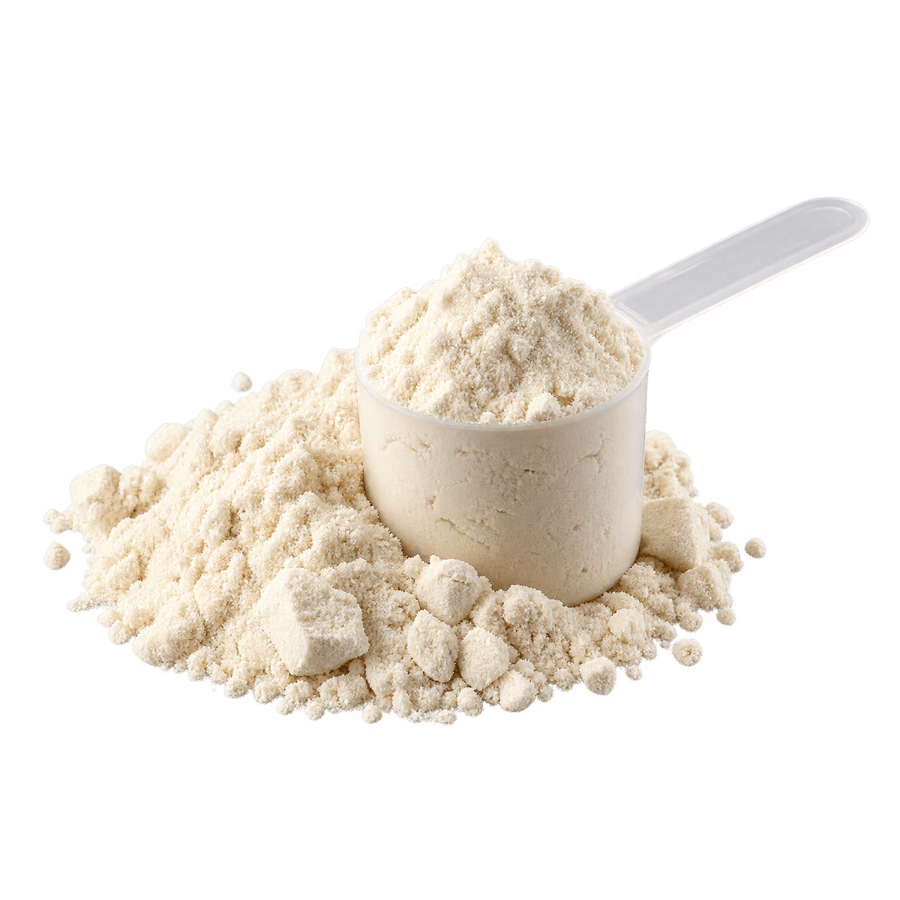
A product with at least one ingredient a kitchen doesn’t keep, from either of two lists. The first is substances kitchens rarely use, like high-fructose corn syrup, maltodextrin, dextrose, hydrogenated oils, soy protein isolate, casein and whey protein. The second is cosmetic additives, like flavors, colors, emulsifiers, emulsifying salts, sweeteners and thickeners.
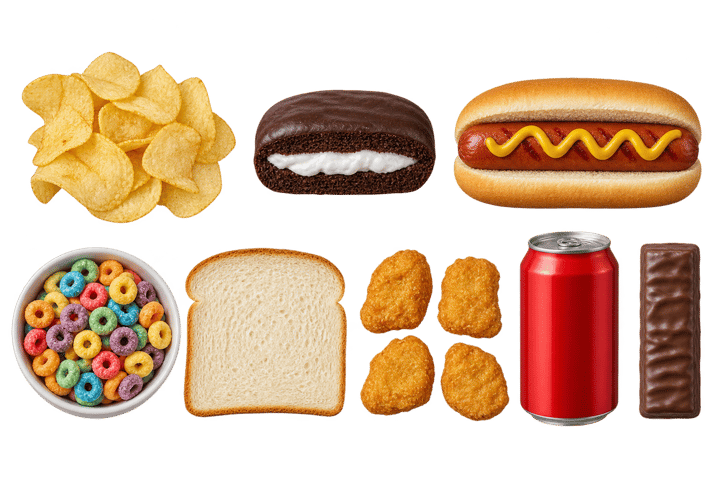
The 2019 NOVA paper lists soft drinks, packaged snacks, candy, ice cream, mass-produced packaged breads and buns, margarine, cookies, cakes, breakfast cereals, nuggets, sausages, burgers and hot dogs, and instant soups and noodles. The 2018 paper adds sugared fruit yogurts. In the US these foods make up 53.0% of the calories adults eat, by the CDC’s 2021 to 2023 count.
The foods people get wrong
| Food | Group | What decides it |
|---|---|---|
| Frozen peas | 1 | Freezing is a minimal process |
| Dried pasta of flour and water | 1 | Named in group 1 by NOVA’s 2018 paper |
| Plain Greek yogurt | 1 | Milk and cultures, fermented |
| Plain rolled oats | 1 | Rolled and dried, nothing added |
| Air-popped popcorn | 1 | Corn and heat |
| Honey, butter, olive oil, table sugar | 2 | Kitchen ingredients |
| Canned black beans with salt | 3 | A food plus salt |
| Cheddar | 3 | Milk, salt, cultures and rennet |
| Canned tuna | 3 | Fish, water and salt |
| Bakery sourdough of flour, water and salt | 3 | A food plus salt, even from a factory |
| Peanut butter of peanuts and salt | 3 | A food plus salt |
| Bacon and ham, cured | 3 | Cured meat, unless the label adds a marker like a flavoring |
| Whey protein powder | 4 | Whey protein is on NOVA’s list |
| Packaged sliced bread, white or whole wheat | 4 | An emulsifier, gluten or dough conditioner on the label |
| Fruit yogurt | 4 | A flavoring or thickener |
| Oat milk with a gum like gellan | 4 | A thickener. Oats, water and salt alone would be group 3 |
| Wrapped cheese slices | 4 | Emulsifying salts such as sodium citrate |
| Peanut butter with fully hydrogenated oil | 4 | A hydrogenated oil |
| Breakfast cereal with a flavoring | 4 | The flavoring. NOVA calls plain corn flakes minimally processed |
| Hot dogs and sausages | 4 | NOVA’s own examples of reconstituted meat |
| Diet soda | 4 | A sweetener, plus color and flavors |
| Instant ramen | 4 | Flavor enhancers in the packet |
Every group 3 and 4 line above depends on the label. A peanut butter, a loaf or an oat milk with a different recipe can sit in a different group, which is why the checker shows the deciding ingredient and the label checker lights it up in your own text.
A shelf in four bays
Picture one long store shelf split into four bays. The first bay holds food that looks like it did on the farm, only cleaned, frozen or dried. The second holds the jars and bottles you cook with. In the third, a food from the first bay has met something from the second, like beans with salt in a can or milk with salt turned into cheese.
The fourth bay holds things built in a factory from parts, where at least one part never sits in a home kitchen. You can’t make a whey isolate, a modified starch or an emulsifier at home, and that’s the whole difference between the third bay and the fourth.
The model breaks at the edges. A rotisserie chicken can be bay 3 or bay 4 depending on whether the store added a flavoring or sodium phosphate, and two loaves that look the same can sit in different bays.
How sure is anyone about the groups?
For most foods the call is easy. In a 2022 French study, about 160 food and nutrition specialists sorted 120 labeled products, and a cluster of 90 of them went to group 4 in 91% of calls. Across all the products, though, agreement was low (a Fleiss’ kappa of 0.32), so experts do disagree about the foods in the middle.
The rule this site follows removes most of that doubt. A food is group 4 when its label lists a marker, group 3 when it has a kitchen ingredient added, and group 1 when it has nothing added. We never assign a group from a food’s name alone.
The groups say nothing about nutrition
Packaged whole wheat bread is group 4, and two slices have 3.8 g of fiber against 1.2 g in packaged white bread, which is also group 4 (USDA figures). Bakery sourdough is group 3 with 1.6 g. Bacon is group 3 and whole wheat bread is group 4. The groups describe making, and nothing more, so the tools here put protein, fiber and added sugar beside every group, and processing isn’t the same thing as nutrition explains why we never turn the group into a score.
See your own foods sorted
- Spot the ultra-processed: ten rounds, two foods each. Guess, then see the label.
- The swap ladder: each staple from group 4 down to group 1, with its nutrition.
- What are the four NOVA groups?, the short answer.
6 sources
- Monteiro et al., Ultra-processed foods: what they are and how to identify them, Public Health Nutrition, 2019pmc.ncbi.nlm.nih.gov
- Monteiro et al., The UN Decade of Nutrition, the NOVA food classification and the trouble with ultra-processing, Public Health Nutrition, 2018pmc.ncbi.nlm.nih.gov
- Braesco et al., Ultra-processed foods: how functional is the NOVA system?, European Journal of Clinical Nutrition, 2022pmc.ncbi.nlm.nih.gov
- World Health Organization, Cancer: carcinogenicity of the consumption of red meat and processed meat, questions and answers, checked 2026-11-14who.int
- Gebhardt and Thomas, Nutritive Value of Foods, USDA Home and Garden Bulletin 72, 2002ars.usda.gov
- Williams et al., Ultra-processed food consumption in youth and adults: United States, August 2021 to August 2023, NCHS Data Brief 536, 2025cdc.gov