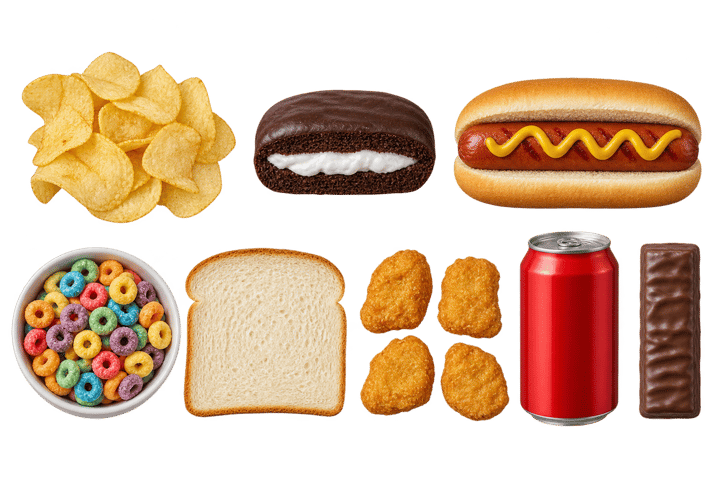
How to eat less of it without cooking all day
On this page
Swap the packaged staples you buy every week, one at a time, starting with the five foods that carry most of America’s ultra-processed calories: sandwiches and burgers, sweet bakery, sweet drinks, salty snacks and bread. Change one a week and cook one dinner from raw ingredients. Each swap repeats every time you eat it.
What we’d do
Make one swap a week, starting with the thing you eat most often, and lean on the fast foods that are already groups 1 to 3: frozen vegetables, canned beans and fish, dried pasta, oats, eggs, plain yogurt and bread made of flour, water and salt. Keep the group 4 foods that do a job for you, like a gel on a long ride, a protein shake that replaces a pastry or a whole wheat loaf you’ll actually eat. You don’t need to cook every meal to get under 30%.
If you remember three things
- Swap what you eat every day. A daily sandwich or soda moves your share far more than a weekly treat.
- Fast whole food already exists. Frozen peas, canned beans and dried pasta aren’t ultra-processed.
- Keep what does a job. The group is a fact about making, and a shake, a gel or a fiber-rich loaf can still earn its place.
Why people give up
Plans to quit ultra-processed food often go the same way. They start with a big clean-out, a weekend of meal prep and a rule against anything in a package. By the second week the prep has run out, the rules make every meal a decision, and the old staples come back.
The all-or-nothing plan also aims at the wrong foods. People cut candy and chips first, because those look like junk. But in the CDC’s count, sandwiches and burgers carry about twice the ultra-processed calories that sweet drinks do, and bread, rolls and tortillas carry nearly as many as salty snacks.
Change the default
A swap in the cart works like changing a default setting on your phone. You decide once, at the store, and then every breakfast that week is already decided. You don’t have to win the argument with yourself every morning, because the cereal isn’t in the cupboard.
That’s why we start with staples. A swap you make once at the store repeats every day you eat that food, and a meal you cook once only counts once.
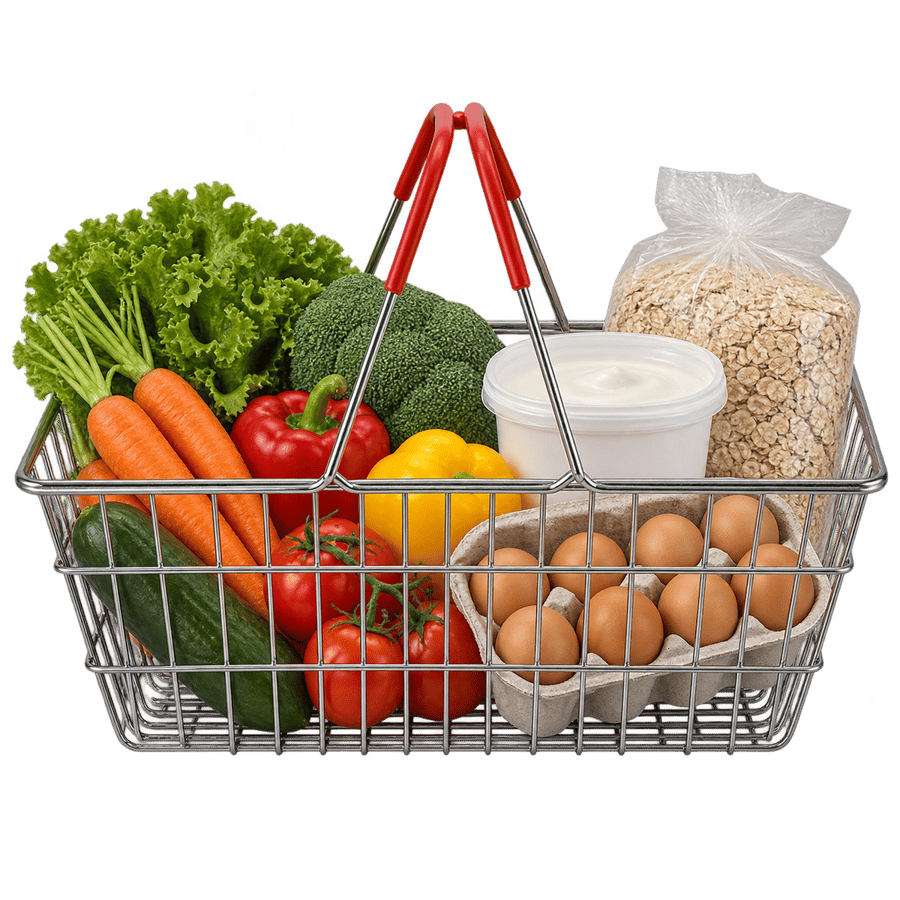
The five big sources, one swap each
These are the CDC’s top five sources of ultra-processed calories for US adults, in order, with a swap for each. The numbers come from the same USDA table and plate rule as the checker.
| Source (share of adults’ calories) | Swap | What it does |
|---|---|---|
| Sandwiches and burgers (8.6%) | Roast turkey for deli turkey in a sandwich on packaged whole wheat with mayonnaise | The sandwich goes from 100% ultra-processed to 70%, and protein from 14 g to 25 g. Avocado for the mayonnaise takes it to 53% |
| Sweet bakery (5.2%) | Plain Greek yogurt and blueberries for a doughnut | 242 calories, 4 g of protein and 13.7 g of sugar become 140 calories and 18 g of protein, with no added sugar |
| Sweet drinks (4.4%) | Sparkling water for a 12 oz cola | 152 calories and 36.8 g of sugar become none |
| Salty snacks (3.4%) | Three cups of air-popped popcorn for an ounce of chips | 152 calories and 1.3 g of fiber become 93 calories and 3.6 g of fiber |
| Bread, rolls and tortillas (3.1%) | Two corn tortillas for two flour tortillas | 208 calories and 2.2 g of fiber become 116 calories and 2.8 g of fiber |
Two of those swaps keep some group 4. The sandwich still has packaged bread, and we’d leave it, since packaged whole wheat has three times the fiber of packaged white. If you want the loaf down a group too, bakery bread of flour, water and salt is group 3, though it has less fiber.
Breakfast is the easiest win
Breakfast is the meal people repeat most, so it’s where one swap pays the most. A bowl of corn flakes with a cup of 2% milk is 223 calories, 46% of them ultra-processed, with 10 g of protein and 0.8 g of fiber. A cup of oatmeal with the same milk is 0% ultra-processed, with 14 g of protein and 4.0 g of fiber. Eggs or plain Greek yogurt with fruit do the same job.
What should I eat for breakfast instead of cereal? has more.
A pantry that’s fast
Most of the time, ultra-processed food wins because it’s quick. These are just as quick and sit in groups 1 to 3 under NOVA’s rules:
- Frozen vegetables and fruit. Freezing is a minimal process. Group 1.
- Canned beans, tomatoes and fish. A food plus salt or water. Group 3.
- Dried pasta of flour and water, rice and rolled oats. Group 1.
- Eggs, milk and plain yogurt. Group 1.
- Cheese and bread of flour, water, salt and yeast. Group 3.
- Jarred tomato sauce of tomatoes, oil and salt. Group 3, if nothing else is on the label.
- Nuts and peanut butter of peanuts and salt. Groups 1 and 3.
A frozen spaghetti meal is 255 calories and 14 g of protein, all of it ultra-processed. Dried spaghetti with a jar of tomato sauce and ground beef you brown yourself takes about the time it takes to boil water, and a plate is 499 calories and 30 g of protein, with nothing ultra-processed.
Old tips that still work
Gyroscope’s first guide to processed food had a list of practical swaps. These still hold up under NOVA’s rules.
- Make your own dressing. A big salad with chicken and bottled Italian dressing is 290 calories, 48% of them ultra-processed. A spoon of olive oil and vinegar takes it to 0%.
- Buy plain yogurt and add fruit. Fruit yogurt cups are group 4. Plain yogurt with berries is group 1.
- Snack on whole food. Nuts, fruit and air-popped popcorn are group 1.
- Make oatmeal or overnight oats with fruit in place of boxed cereal.
- Cook in batches and freeze your own. Soup, chili and burritos you freeze yourself are as fast on a weeknight as the store’s, without the markers.
- Choose whole grain over refined. Brown rice, whole wheat pasta and oats. On NOVA’s test these are group 1, and they bring fiber.
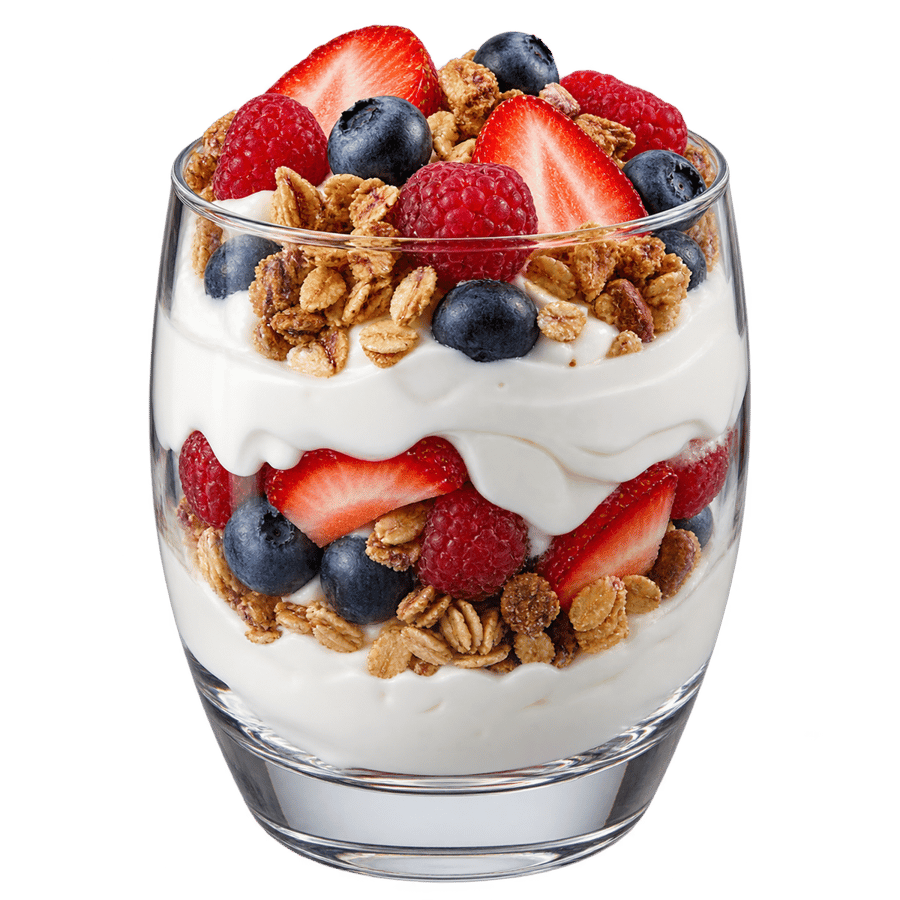
What to keep
Some group 4 foods do a job that nothing else does as well. Keep them, and swap something else.
- Gels and sports drinks during long endurance sessions. They’re built to go down fast, which is the point when you’re two hours into a ride.
- A protein shake that replaces a pastry. Both are group 4, and the shake brings protein the pastry doesn’t. Whether powder counts toward your protein is protein.guide’s subject.
- Packaged whole wheat bread you’ll eat. It has about three times the fiber of packaged white.
- A nutrition drink a doctor or dietitian prescribed. Don’t stop one without talking to your care team.
On a GLP-1 medicine, when you eat less, the foods you keep carry more of your protein and fiber. Does ultra-processed food matter on a GLP-1? covers that.
What it costs
It often costs more. On the NIH ward, the researchers estimated the ingredients for 2,000 calories a day at $106 a week on the ultra-processed menu and $151 on the unprocessed one, at one supermarket chain. In a 2024 study, a less processed copy of a typical American menu cost $15.91 a day against $9.85, and its food expired sooner, a median of 35 days against 120.
The staples that keep for months, like oats, dried beans and lentils, rice, frozen vegetables and canned fish, are the place to start if cost is the worry. Does eating less ultra-processed food cost more? has the full comparison.
Run your own 8-week test
The 2025 England trial is a test you can copy. For 8 weeks, people ate as much as they wanted from a minimally processed diet built to the UK’s healthy eating guide. They lost 2.06% of their body weight, against 1.05% on an ultra-processed diet built to the same guide. For a 180 lb person, that’s about 3.7 lb against 1.9 lb.
- Write down what you eat on a normal day, or pick it in your day’s share.
- Swap the staple that carries the most, using the swap ladder. Add one more each week.
- Eat as much as you like. The trial didn’t limit calories.
- Weigh yourself once a week, same morning, same scale, and keep a note of how hungry you are between meals.
To check it for a week, photograph your meals in Gyroscope. Take a photo of your meal to estimate calories, macros and micronutrients. Food XRAY connects your nutrition with your health data and AI coach. See tracking it in Gyroscope.
8 sources
- Williams et al., Ultra-processed food consumption in youth and adults: United States, August 2021 to August 2023, NCHS Data Brief 536, 2025cdc.gov
- Hall et al., Ultra-processed diets cause excess calorie intake and weight gain: an inpatient randomized controlled trial of ad libitum food intake, Cell Metabolism, 2019pmc.ncbi.nlm.nih.gov
- Dicken et al., Ultraprocessed or minimally processed diets following healthy dietary guidelines on weight and cardiometabolic health: a randomized, crossover trial, Nature Medicine, 2025pmc.ncbi.nlm.nih.gov
- Hess et al., Using less processed food to mimic a standard American diet does not improve nutrient value and may result in a shorter shelf life at a higher financial cost, Current Developments in Nutrition, 2024pmc.ncbi.nlm.nih.gov
- Monteiro et al., Ultra-processed foods: what they are and how to identify them, Public Health Nutrition, 2019pmc.ncbi.nlm.nih.gov
- Monteiro et al., The UN Decade of Nutrition, the NOVA food classification and the trouble with ultra-processing, Public Health Nutrition, 2018pmc.ncbi.nlm.nih.gov
- Gebhardt and Thomas, Nutritive Value of Foods, USDA Home and Garden Bulletin 72, 2002ars.usda.gov
- US Departments of Agriculture and Health and Human Services, Dietary Guidelines for Americans, 2025 to 2030cdn.realfood.gov