Does ultra-processed food matter on a GLP-1?
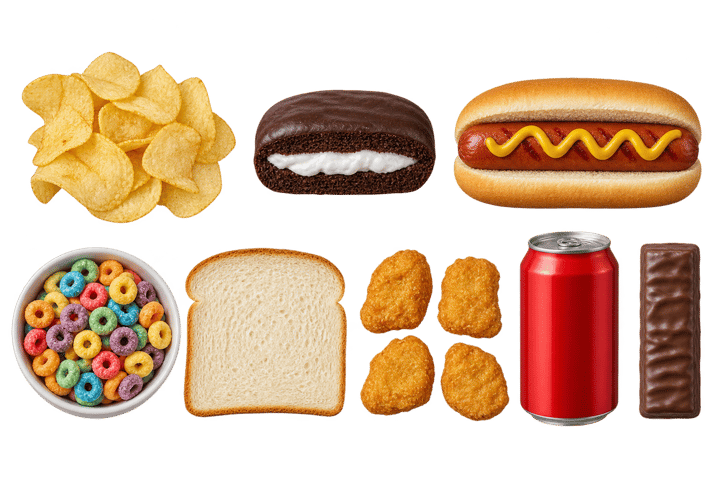
Yes, though not in the way people expect. When a GLP-1 cuts your appetite, every bite carries more of the day’s protein, fiber and vitamins. The 2025 joint advisory from four obesity and nutrition societies recommends more minimally processed, nutrient-dense food and fewer starch- and sugar-rich ultra-processed foods. Keep group 4 foods that do a job, like a protein shake, and drop the ones that only add calories.
Some people on a GLP-1 figure that what they eat barely matters now, since they’re eating so much less of it. Others decide every packaged food has to go. The first misses that a smaller amount of food has to cover the same needs. The second throws out some of the most useful tools for getting protein in when you’re not hungry.
We’d sort your food by the job it does. A protein shake or a Greek yogurt on a morning you can’t face breakfast does a job. A pastry, chips or a soda mostly takes up room you don’t have. Eat the protein first at meals, as the advisory suggests, and let the rest follow.
Eating on a GLP-1 is like packing a carry-on instead of a suitcase. Everything still has to fit, so the things that earn their space go in first.
What the advisory says
In May 2025, the American College of Lifestyle Medicine, the American Society for Nutrition, the Obesity Medicine Association and The Obesity Society published joint advice on eating with GLP-1 drugs. Among its eight priorities:
| Priority | What it says |
|---|---|
| The diet | Personalized, nutrient-dense, minimally processed food. “Eating more minimally processed, nutrient-dense foods and fewer starch and sugar rich ultraprocessed foods” |
| Protein | Higher targets, “such as 1.2 to 1.6 g/kg body weight/day”, during active weight loss, with strength training to keep muscle |
| At meals | “Protein-rich foods can be consumed first in a meal to increase the likelihood of sufficient consumption” |
| Low appetite | Smaller, more frequent meals, and lower-volume protein foods like fish and eggs |
The advisory also notes that some people on these drugs report fewer cravings for ultra-processed foods and more interest in minimally processed ones.
Protein per calorie
When you eat less, you need more protein out of each calorie. From the site’s food table (USDA):
| Food | Group | Calories | Protein |
|---|---|---|---|
| Plain Greek yogurt and blueberries | 1 | 141 | 18 g |
| 2 hard-boiled eggs | 1 | 156 | 12 g |
| A glazed doughnut | 4 | 242 | 4 g |
| Cola, 12 fl oz | 4 | 152 | 0 g |
A protein shake belongs on the useful side even though it’s group 4, since whey protein is on NOVA’s list by definition. The protein shake rung of the swap ladder shows the trade.
Doses, side effects and whether a GLP-1 is right for you stay with your prescriber. bodyfat.guide has a guide to each GLP-1 drug, and protein.guide covers protein targets in more detail.
What we’d do
- Eat the protein first at each meal.
- Keep the group 4 foods that do a job, like a shake on low-appetite mornings.
- Drop the ones that only add calories, like sweet drinks and pastries. Find yours in the two-minute quiz.
- Build the rest from whole food, if you can, since a small appetite leaves less room for food that only adds calories. How to eat less of it has the order to go in.
5 sources
- Mozaffarian et al., Nutritional priorities to support GLP-1 therapy for obesity: a joint advisory from the American College of Lifestyle Medicine, the American Society for Nutrition, the Obesity Medicine Association and The Obesity Society, Obesity Pillars, 2025pmc.ncbi.nlm.nih.gov
- The Obesity Society, Nutritional priorities to support GLP-1 therapy for obesity, press release, May 30, 2025obesity.org
- Monteiro et al., Ultra-processed foods: what they are and how to identify them, Public Health Nutrition, 2019pmc.ncbi.nlm.nih.gov
- Gebhardt and Thomas, Nutritive Value of Foods, USDA Home and Garden Bulletin 72, 2002ars.usda.gov
- USDA Standard Reference, Yogurt, Greek, plain, nonfat, the row in this site's food tablenutritionvalue.org