How much ultra-processed food do kids eat?
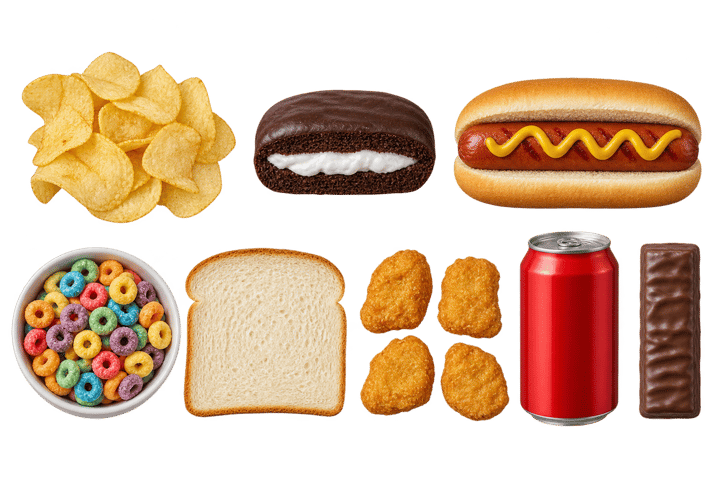
About 62% of their calories. US children and teens get 61.9% of their calories from ultra-processed food, more than adults at 53.0% (CDC, 2021 to 2023), and kids aged 6 to 11 get the most, 64.8%. The useful moves are the lunchbox and the breakfast bowl, and the useful attitude is no food fear.
Parents hear two things at once. One is that ultra-processed food is wrecking kids’ health. The other is that kids are picky, and anything that gets food into them counts as a win. Both make it feel hopeless. The CDC’s numbers show the share is high but has been falling, and where it comes from is a short list.
We’d swap a few staples without a fuss and never call a food good or bad at the table. Kids eat what’s in the house and what’s in the lunchbox. Change those, keep the treats as treats, and don’t turn dinner into a lecture.
The numbers
| Age | Share of calories from ultra-processed food |
|---|---|
| 1 to 5 | 56.1% |
| 6 to 11 | 64.8% |
| 12 to 18 | 63.0% |
| All children and teens, 1 to 18 | 61.9% |
| Adults, 19 and up | 53.0% |
The youth share rose to 65.6% in 2017 to 2018 and fell to 61.9% by 2021 to 2023 (CDC).
Where it comes from
The five biggest sources for kids and teens, as a share of all their calories (CDC):
| Source | Share of calories |
|---|---|
| Sandwiches, including burgers | 7.6% |
| Sweet bakery products | 6.3% |
| Savory snacks | 4.9% |
| Pizza | 4.7% |
| Sweetened drinks | 3.9% |
Most of that list fits in a lunchbox, a snack drawer or a cup.
What the guidelines say
The 2025 to 2030 US guidelines say adolescents should be “avoiding highly processed foods”, and that infants should get nutrient-dense foods “while avoiding nutrient-poor and highly processed foods” (pages 6 and 7). They also say it may take 8 to 10 tries before a young child is willing to eat a new food, so a refusal on day one isn’t the final answer.
Swaps to try
| Instead of | Try | Group |
|---|---|---|
| Fruit yogurt tubes | Plain yogurt with fruit stirred in | 1 |
| Packaged deli meat | Leftover roast chicken | 1 |
| Flavored chips | Apple slices or a cheese stick | 1 and 3 |
| Juice drinks and soda | Water or plain milk | 1 |
| Boxed cereal | Oatmeal with banana | 1 |
Keep the packaged whole wheat bread if it’s what makes the sandwich happen. It’s group 4 and has about three times the fiber of white.
What we’d do
- Change the lunchbox first, one item a week.
- Offer new foods again and again without pressure, as the guidelines suggest.
- Check the swap ladder for the staples you buy most, and take the quiz for your own day, since the kids mostly eat what you buy.
5 sources
- Williams et al., Ultra-processed food consumption in youth and adults: United States, August 2021 to August 2023, NCHS Data Brief 536, 2025cdc.gov
- US Departments of Agriculture and Health and Human Services, Dietary Guidelines for Americans, 2025 to 2030cdn.realfood.gov
- Monteiro et al., NOVA. The star shines bright, World Nutrition, 2016worldnutritionjournal.org
- American Academy of Pediatrics, HealthyChildren.org, Nutrition, checked November 15, 2026healthychildren.org
- Nemours KidsHealth, How to raise a healthy eater, checked November 15, 2026kidshealth.org