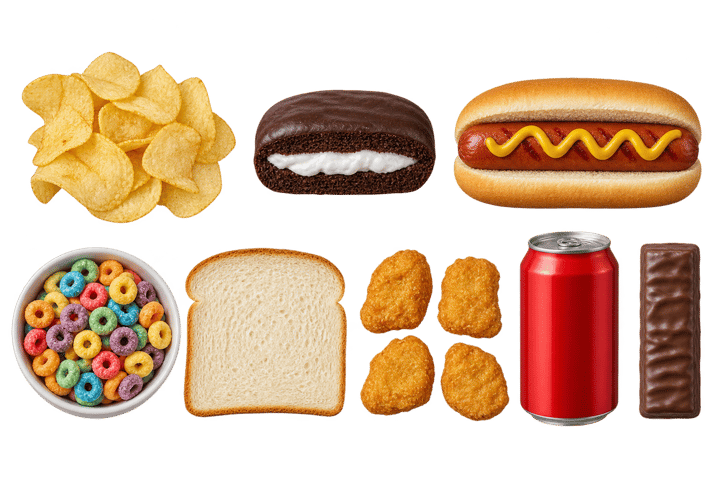
Ultra-processed food only makes you gain weight because of the sugar and fat
Short answerNo
On this page
No. In a 2019 trial at the National Institutes of Health, the ultra-processed and unprocessed menus offered the same calories, sugar, fat, fiber and salt, and people still ate 508 more calories a day on the ultra-processed one. They ate it 17 calories a minute faster. Speed and softness explain more of the gap than the nutrients on the label.
What we’d do
Don’t swap one packaged food for another just because its sugar and fat numbers look better. Pick the version you have to chew, like oatmeal over cereal, fruit over fruit snacks, a potato over chips, since slower food gives fullness time to catch up. Then check the numbers too, because sugar and fat still count.
If you remember three things
- The menus matched on paper. Same calories, sugar, fat, fiber and salt offered, and a 508 calorie gap.
- Two more trials agree. Tokyo found 813 more calories a day, and England found half the weight loss on diets built to the same healthy guide.
- Speed is the best lead. Harder lunches cut intake by about 300 calories in a Singapore study.
Why people believe it
It’s the simplest explanation. Chips, cookies and soda are full of sugar and fat, sugar and fat have calories, and calories put on weight. If that’s all there is to it, you could eat ultra-processed food that matches whole food on the label and get the same result.
Kevin Hall’s team at the National Institutes of Health set out to test exactly that.
The menus that matched
In the 2019 trial, 20 adults lived at the NIH Clinical Center for four weeks. For two weeks they got an ultra-processed menu and for two weeks an unprocessed one, in random order. The team built the two menus to offer the same calories, the same calories per gram, and the same protein, carbs, fat, sugar, salt and fiber. People could eat as much or as little as they liked.
On the ultra-processed menu they ate 508 calories a day more and gained about 2 pounds in two weeks. On the unprocessed menu they lost about 2 pounds. The menus were rated about equally pleasant, and people didn’t report feeling hungrier on either. They ate the ultra-processed meals 17 calories a minute faster.
Juice and oranges
A glass of orange juice goes down in a minute, and eating the oranges it was squeezed from would take a lot longer, though the sugar is the same. Your stomach and gut need time to tell your brain you’ve eaten, and fast food in the literal sense gets in before they do. Ultra-processed food is often closer to the juice than to the orange, even when it’s solid.
Two more trials
- Tokyo, 2024. 9 men with overweight or obesity spent one week on each menu, matched for calories and the big nutrients. They ate 813 more calories a day on the ultra-processed week, gained 2.4 pounds (1.1 kg) more, and chewed less for every calorie.
- England, 2025. 55 adults spent 8 weeks on each of two diets, both built to the UK’s healthy eating guide, so neither was a junk food diet. They lost 2.06% of their body weight on the minimally processed diet and 1.05% on the ultra-processed one.
What does explain it
The best lead is how fast the food goes down. In a 2022 study in Singapore, 50 adults ate four lunches matched for calories served. They ate 789 calories of the soft ultra-processed lunch and 483 of the hard minimally processed one, because harder food took longer to eat. Across 2,733 meals on the NIH ward, the meals that were denser, eaten faster or built from very tasty food combinations were the ones people ate more of.
Why ultra-processed food makes you eat more walks through the steps.
The best case for the belief
The sugar and fat camp has a fair point about the NIH menus. They matched on what was offered, and in the end people on the ultra-processed menu ate more of both, about 280 extra calories a day from carbs and 230 from fat, with protein unchanged. The solid food on the ultra-processed side also had about 85% more calories per gram, and the fiber was matched partly by dissolving fiber supplements in drinks.
The sugar and fat did arrive, in larger amounts. But with the same sugar and fat on the table, people ate more of them when the food was ultra-processed. Something about the food, most likely its softness, density and speed, moved how much went down. The calories still did the rest, and bodyfat.guide explains why a calorie is a calorie and still isn’t.
What to do
- Choose food you chew: whole fruit, oats, beans, potatoes, nuts, meat and fish you cook.
- Don’t trust a “reduced sugar” or “low fat” label to fix a soft, dense food.
- Try the swap on yourself for two weeks with your day’s share and a weekly weigh-in.
5 sources
- Hall et al., Ultra-processed diets cause excess calorie intake and weight gain: an inpatient randomized controlled trial of ad libitum food intake, Cell Metabolism, 2019pmc.ncbi.nlm.nih.gov
- Hamano et al., Ultra-processed foods cause weight gain and increased energy intake associated with reduced chewing frequency: a randomized, open-label, crossover study, Diabetes, Obesity and Metabolism, 2024pubmed.ncbi.nlm.nih.gov
- Dicken et al., Ultraprocessed or minimally processed diets following healthy dietary guidelines on weight and cardiometabolic health: a randomized, crossover trial, Nature Medicine, 2025pmc.ncbi.nlm.nih.gov
- Teo et al., Texture-based differences in eating rate influence energy intake for minimally processed and ultra-processed meals, American Journal of Clinical Nutrition, 2022pmc.ncbi.nlm.nih.gov
- Fazzino, Courville, Guo and Hall, Ad libitum meal energy intake is positively influenced by energy density, eating rate and hyper-palatable food across four dietary patterns, Nature Food, 2023pubmed.ncbi.nlm.nih.gov