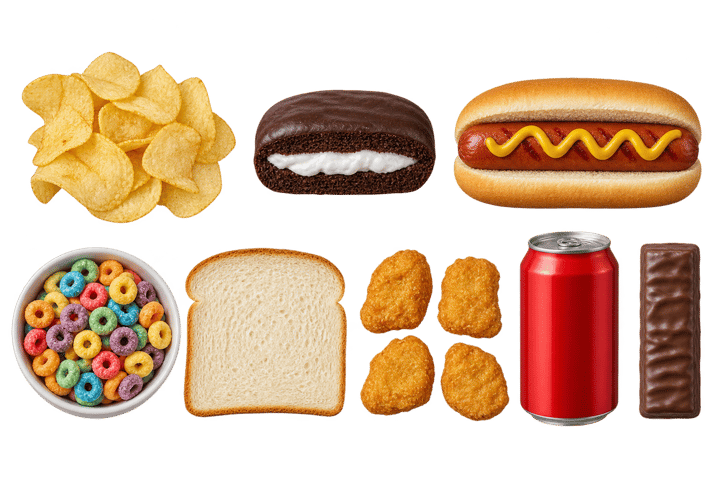
Ultra-processed just means junk food
Short answerNot the way you think
On this page
Not the way most people mean it. Soda, chips and candy are ultra-processed, and so are most packaged sliced bread, fruit yogurt, many breakfast cereals, oat milk with added gums and every whey protein powder. The test is one ingredient a home kitchen doesn’t keep, and it has nothing to do with how sweet or greasy a food is.
What we’d do
Stop sorting by how a food looks and check the foods you think of as healthy, since that’s where ultra-processed food hides in most carts. Start with the bread, the yogurt, the cereal and the plant milk you buy every week. Then decide on nutrition, because some of those group 4 foods are still good choices.
If you remember three things
- Health foods land in group 4 all the time. Whey protein, fruit yogurt and packaged whole wheat bread all carry a marker.
- Bread and sandwiches carry more than candy. In the US, sandwiches and burgers carry about twice the ultra-processed calories of sweet drinks.
- Some junk food isn’t ultra-processed. A cake baked at home from flour, butter, sugar and eggs has no marker.
Why people believe it
The words sound like a description of junk food. “Ultra” suggests something extreme, and people file it next to fast food, as something they eat on a bad day.
But NOVA, the system researchers use, was built to describe how food is made, and junk never came into it. A food is group 4 when its ingredient list has something a home kitchen doesn’t keep, like high-fructose corn syrup, maltodextrin, whey protein, a hydrogenated oil, or a flavoring, color, emulsifier, sweetener or thickener, however healthy it looks.
Like a work uniform
Think of group 4 as a uniform. It tells you where a food was made and how, the way a uniform tells you where someone works. It doesn’t tell you whether that someone is good at their job. Soda and a whole wheat loaf wear the same uniform, and they’re very different foods.
Foods that surprise people
| Food | Group | What puts it there |
|---|---|---|
| Whey protein powder | 4 | Whey protein is on NOVA’s list of substances kitchens don’t use |
| Packaged sliced bread, white or whole wheat | 4 | An emulsifier, gluten or dough conditioner. NOVA names mass-produced packaged breads |
| Fruit yogurt | 4 | A flavoring or thickener. NOVA names sugared fruit yogurts |
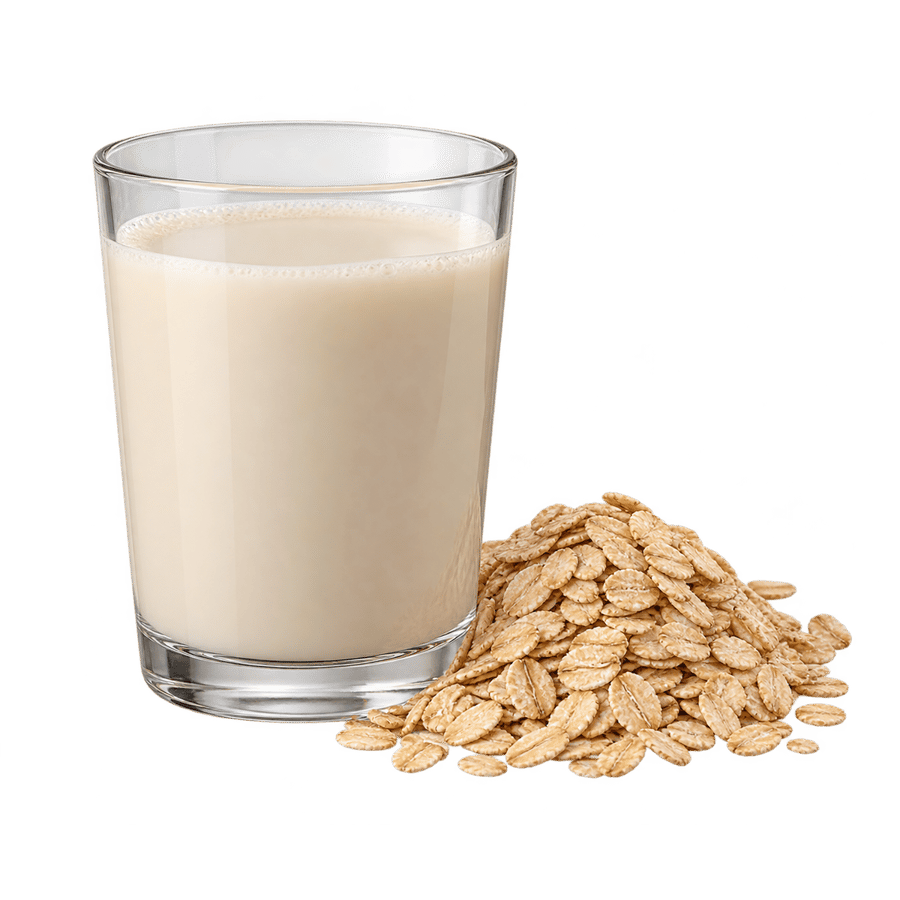
| Oat milk with gellan gum | 4 | A thickener |
| Breakfast cereal with a flavoring | 4 | The flavoring. Plain corn flakes are minimally processed by NOVA’s guide |
| Protein bars | 4 | A protein isolate on the label |
| Diet soda | 4 | A sweetener, plus color and flavors |
The CDC’s count makes the same point at the scale of a whole country. US adults got 53.0% of their calories from ultra-processed food in 2021 to 2023. The biggest source was sandwiches and burgers, at 8.6% of all calories. Sweet bakery was 5.2%, sweet drinks 4.4%, salty snacks 3.4%, and bread, rolls and tortillas 3.1%. Bread and sandwiches together carry more than the soda and the chips.
Junk food that isn’t ultra-processed
The rule works the other way too. A chocolate cake you bake from flour, butter, sugar, eggs and cocoa has nothing on its list a kitchen doesn’t keep, so by NOVA’s test it isn’t ultra-processed, though it’s still a cake. Fries cut from potatoes and fried at home in oil with salt have no marker either.
That’s no reason to bake a cake every night. It shows the group answers a question about making, and a separate question about nutrition still needs an answer.
The best case for the belief
The junk food instinct isn’t useless. Many of the foods it catches, like sweet drinks and sweet bakery, are among the biggest sources of ultra-processed calories, and in a study of 198,636 US adults, sweetened drinks went with higher type 2 diabetes risk. If “ultra-processed means junk” gets someone to drop the daily soda, it did its job.
Where it fails is the rest of the cart. In the same study, dark and whole grain bread, breakfast cereals and yogurt, all ultra-processed, went with lower risk. The junk food idea would never flag them, and it would never tell you that the soft packaged bread in your sandwich is in the same group as the soda.
What to do
- Check the labels on the foods you think of as healthy: bread, yogurt, cereal, plant milk, bars and powders. The label checker lights up the markers.
- Don’t panic when a good food turns out to be group 4. Packaged whole wheat bread has 3.8 g of fiber in two slices against 1.2 g in packaged white (USDA figures). Keep it if you’ll eat it.
- Swap the group 4 foods that do nothing for you first. The swap ladder shows a lower rung for each staple.
5 sources
- Monteiro et al., Ultra-processed foods: what they are and how to identify them, Public Health Nutrition, 2019pmc.ncbi.nlm.nih.gov
- Monteiro et al., The UN Decade of Nutrition, the NOVA food classification and the trouble with ultra-processing, Public Health Nutrition, 2018pmc.ncbi.nlm.nih.gov
- Williams et al., Ultra-processed food consumption in youth and adults: United States, August 2021 to August 2023, NCHS Data Brief 536, 2025cdc.gov
- Chen et al., Ultra-processed food consumption and risk of type 2 diabetes: three large prospective U.S. cohort studies, Diabetes Care, 2023pmc.ncbi.nlm.nih.gov
- Gebhardt and Thomas, Nutritive Value of Foods, USDA Home and Garden Bulletin 72, 2002ars.usda.gov