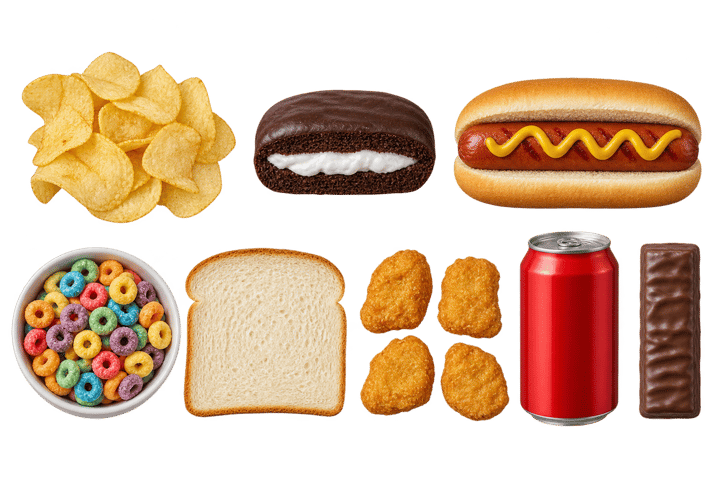
The additives are what make ultra-processed food harmful
Short answerSort of
On this page
Sort of. Some additives may do harm of their own, and one small trial found an emulsifier changed gut bacteria in healthy people within 11 days. But the clearest harm the trials measured is that people eat more of soft, dense, fast food, and that happens with or without any one additive. Nobody knows yet how much the additives add on top.
What we’d do
Cut back on the foods, and the additives go with them. Hunting for single additives across a store full of products is a lot of work for a small and uncertain payoff. Eating fewer group 4 foods takes care of the overeating, which is the effect with the strongest evidence, and takes most of the emulsifiers, sweeteners, flavors and colors out of your day at the same time.
If you remember three things
- There’s real early evidence on emulsifiers. One 11-day trial in 16 people and one French cohort of 95,442 adults.
- Overeating is the best proven harm. People ate 508 more calories a day on ultra-processed menus, 17 calories a minute faster.
- Cutting the foods cuts both. You don’t have to know which one does more harm.
Why people believe it
Additives are the part of ultra-processed food that whole food never has. They have long names, E-numbers in Europe, and a reputation built on viral lists. When a study says ultra-processed food is linked to disease, the additives look like the obvious culprit, since they’re the thing that’s different.
NOVA does use additives to define group 4. Flavors, colors, emulsifiers, sweeteners and thickeners are all markers. But using them to recognize the food isn’t the same as proving they’re what does the harm.
The smoke and the fire
Additives work a bit like smoke from a kitchen. Smoke tells you something is cooking, and sometimes the smoke itself is a problem. But if the pan is on fire, clearing the smoke won’t help. In ultra-processed food, the additives are the visible sign of how the food was made, and the way it was made, soft, dense and quick to eat, may be the bigger problem.

The case for the additives
An emulsifier in the gut
16 healthy adults, 11 days on a fully controlled diet, 7 of them with 15 g a day of carboxymethylcellulose. Chassaing and colleagues, 2022
The emulsifier group had a little more stomach discomfort after meals, less varied gut bacteria and fewer short-chain fatty acids. In two of the seven, bacteria had moved into the inner mucus layer that normally keeps them off the gut wall.
Tiny and short, with one emulsifier at one dose.
Emulsifiers and heart disease
95,442 French adults followed for a median of 7.4 years. Sellem and colleagues, 2023
More of the cellulose emulsifiers went with 5% higher risk of cardiovascular disease for each step up in intake, and mono- and diglycerides with higher risk of every outcome measured.
An observational study with small effects. People who eat more emulsifiers eat more ultra-processed food overall.
The authors of the 2025 Lancet series on ultra-processed food list potentially harmful classes and mixtures of additives among the ways these foods may damage health, alongside overeating and poor nutrition.
The case for the food
On the NIH ward in 2019, 20 adults ate 508 more calories a day on an ultra-processed menu than on an unprocessed one, with sugar, fat, fiber and salt matched on paper, and gained about 2 pounds in two weeks. They ate 17 calories a minute faster. In a 2022 lunch study in Singapore, a soft ultra-processed lunch came to 789 calories eaten and a hard minimally processed one to 483, served in the same amount.
Those effects come from texture, density and speed. In the Singapore study, the soft minimally processed lunch was also eaten in larger amounts than the hard one, with no ultra-processed food involved. And 508 calories a day is enough on its own to explain weight gain over months.
Where that leaves the additives
Both cases can be true. Overeating is the harm with the strongest evidence, from controlled trials in three countries. Specific additives, especially some emulsifiers, have early evidence of effects in the gut and small links with heart disease in one large cohort. Nobody has yet run a trial that separates the additives from the food over months or years.
Some additives have limits set far above normal use. The FDA says a 132 pound person would need about 75 packets of aspartame a day to reach its acceptable daily intake, and its scientists have no safety concerns at approved uses.
What to do
- Swap the foods you eat most, and the additives fall with them. The swap ladder shows a lower rung for each staple.
- If you want to cut additives specifically, the easiest wins are diet soda, bottled dressing and flavored yogurt.
- Paste a label into the label checker to see which additive classes it has.
6 sources
- Chassaing et al., Randomized controlled-feeding study of dietary emulsifier carboxymethylcellulose reveals detrimental impacts on the gut microbiota and metabolome, Gastroenterology, 2022pmc.ncbi.nlm.nih.gov
- Sellem et al., Food additive emulsifiers and risk of cardiovascular disease in the NutriNet-Santé cohort: prospective cohort study, BMJ, 2023pmc.ncbi.nlm.nih.gov
- Hall et al., Ultra-processed diets cause excess calorie intake and weight gain: an inpatient randomized controlled trial of ad libitum food intake, Cell Metabolism, 2019pmc.ncbi.nlm.nih.gov
- Teo et al., Texture-based differences in eating rate influence energy intake for minimally processed and ultra-processed meals, American Journal of Clinical Nutrition, 2022pmc.ncbi.nlm.nih.gov
- Monteiro et al., Ultra-processed foods and human health: the main thesis and the evidence, The Lancet, 2025pubmed.ncbi.nlm.nih.gov
- US Food and Drug Administration, Aspartame and other sweeteners in food, checked 2026-11-14fda.gov